
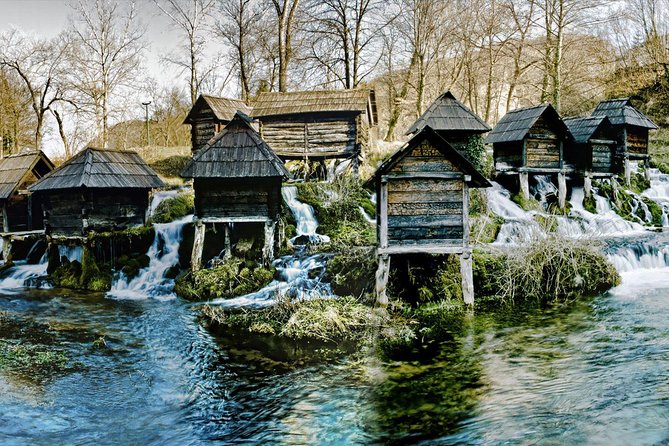
Reviewed · PRIVATE DRIVERS
Sarajevo to/from Zagreb Transfer Day Tour (North-central Bosnia)
The most useful thing about this experience is that it turns a long international transfer into a full day of north-central Bosnia. Instead of piecing together buses and trains, you cross the country by road and stop at Travnik, Jajce, Banja Luka, and Jasenovac.
I like the small-group format, with the vehicle limited to roughly seven or eight people, and I like that several entrance fees are included. The main drawback is the length: with a 7:30 am start and roughly 10 to 12 hours on the road, this is transportation with sightseeing, not a relaxed city tour.
Key points
- Travnik adds Ottoman-era Bosnia with its hilltop fortress and colorful Šarena Džamija mosque.
- Jajce is the scenic highlight, combining a waterfall in the city center with medieval towers, catacombs, and the AVNOJ Museum.
- The Vrbas River canyon gives the drive real scenery, rather than making the day a series of highway stops.
- Banja Luka includes a two-hour guided city visit, giving you more than a quick roadside break.
- Jasenovac brings serious historical weight, with an outdoor visit to the memorial area and a guided explanation.
- The $161.95 price includes several admissions and the transfer, but lunch is extra and the day is long.
Why this transfer works better than a string of buses
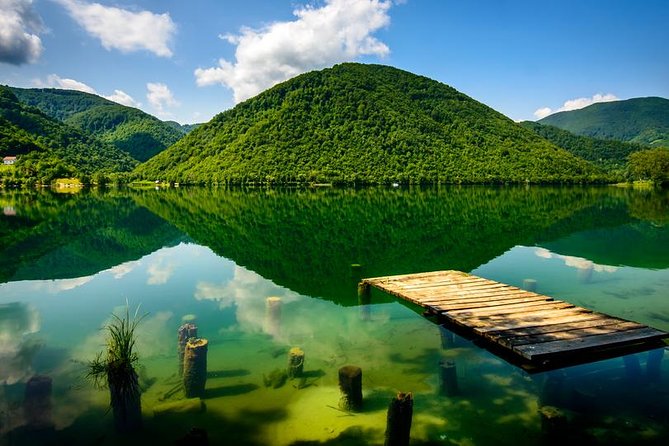
The route between Sarajevo and Zagreb is not a simple point-to-point journey. Unless you rent a car, you would normally need to coordinate several bus or train connections, with limited freedom to stop along the way.
This tour solves that problem in a practical way. You are picked up in Sarajevo or Zagreb, ride in an air-conditioned vehicle, and use the journey to see places that are easy to miss on a direct transfer. You still reach your destination at the end of the day, but the road becomes part of the trip.
The vehicle is described as a small-group service, with a maximum listed between seven and eight people. That matters here. You will need to get in and out often, listen to historical explanations, and keep to a long schedule. A small group makes those movements easier than a full coach.
The day begins at 7:30 am. A one-way journey takes about 10 to 12 hours, and a previous Sarajevo-bound departure from Zagreb reached Sarajevo at around 8 pm. That gives you a useful idea of the rhythm: an early start, steady sightseeing, and an evening arrival.
More private transfers running from Sarajevo
- Sarajevo to/from Dubrovnik Transfer Tour via Mostar & Herzegovina
★ 5.0 · 115 reviews - Sarajevo to Belgrade: Transfer With East Bosnia Tour
★ 5.0 · 63 reviews - Sarajevo to/from Belgrade UNESCO Transfer Day Tour (Fees Incl.)
★ 5.0 · 54 reviews
Travnik brings Ottoman Bosnia into view
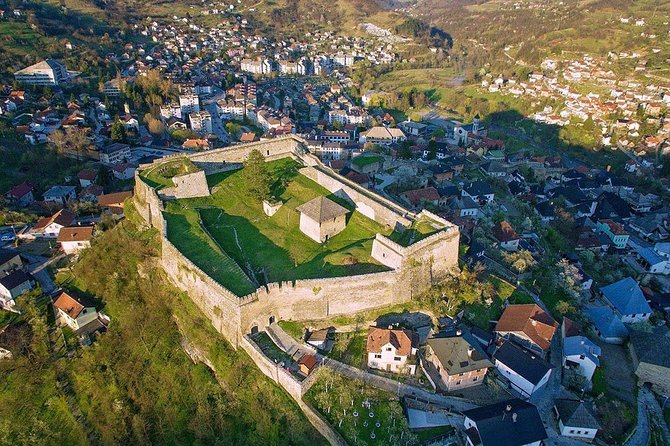
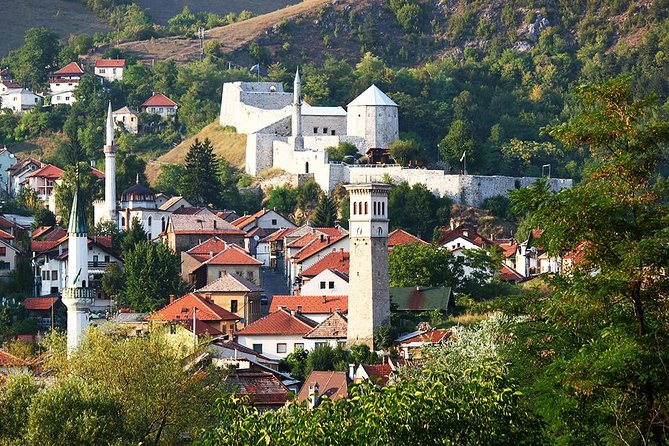
The first substantial stop is Travnik, an old Ottoman town associated with the viziers who governed Bosnia during the Ottoman period. The drive follows the Bosna, Lašva, and Vrbas rivers, so even the approach offers more than a plain transfer route.
You spend time in the old town before visiting Travnik Fortress, one of the best-preserved medieval fortified buildings in Bosnia and Herzegovina. The fortress sits above the town and provides broad views of the surrounding hills and river valley. Its entrance fee, listed as 2 euros per person, is included.
The fortress visit lasts about 30 minutes. That is enough for a look around and a few photographs, but not enough for a slow, detailed examination of every corner. You should think of this as a focused introduction rather than a full Travnik visit.
The next stop is Šarena Džamija, or the Colorful Mosque. Its painted decoration makes it one of the most distinctive mosques in Bosnia and Herzegovina. The visit lasts about 20 minutes and has no separate admission charge.
I like this pairing because the fortress and mosque show two different layers of Travnik in a short space of time. You see military power on the hill and Ottoman religious and civic life in town. If architecture and regional history matter to you, this is one of the most worthwhile early stops.
Jajce packs a remarkable amount into one town
Jajce is the busiest sightseeing section of the day. You will see its famous waterfall, several medieval structures, an underground chapel, and a museum connected to the creation of socialist Yugoslavia.
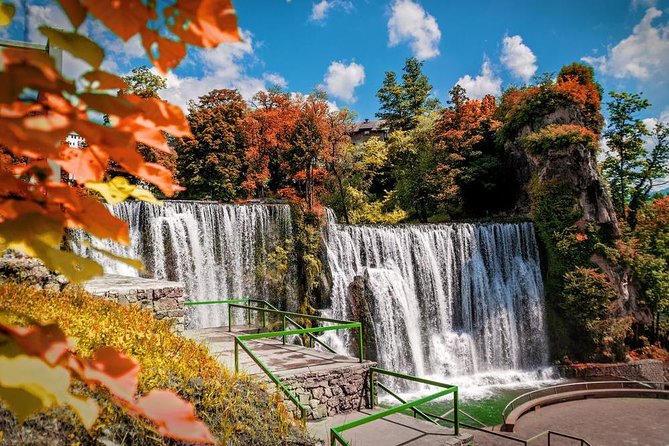
The Pliva Waterfall is the visual centerpiece. The Pliva River drops where it meets the Vrbas, right in the center of Jajce. The unusual setting lets you see a major natural feature without leaving town or hiking into remote country. You have about 30 minutes here, which should allow time to view the falls and take photographs.
The stop is short, so do not expect a long walk around the river or a leisurely café break. Still, the waterfall is easy to appreciate quickly, and it gives Jajce an immediate sense of place.
The Museum of the Second AVNOJ Session explains the political meeting held in Jajce on November 29, 1943. That meeting helped establish the foundations of socialist Yugoslavia. The museum building was reconstructed after the war and later suffered major damage and looting during the 1992 to 1995 conflict.
You get about 30 minutes inside, with the 1 euro admission included. The museum is especially useful if you want to understand why Jajce matters beyond its medieval walls. It connects the town to 20th-century Balkan politics, rather than presenting it only as a picturesque stop.
Medieval Jajce means towers and catacombs
The Catacomb of Jajce lies about six meters underground inside the city walls. It was carved directly into solid rock in the late 14th or early 15th century, when the town was developing as a political and cultural center.
The underground church and crypt were ordered by the Bosnian duke Hrvoje Vukčić Hrvatinić as a burial place for his family. The site has been protected as a national monument of Bosnia and Herzegovina since 2003.
The visit lasts about 30 minutes, and the 2.5 euro entrance fee is included. This is a more enclosed and atmospheric stop than the waterfall or fortress. If you dislike confined spaces, keep that in mind, though the supplied information does not indicate any special access restriction.
You also visit Medvjed Kula, or Bear Tower. Its walls are between 4.5 and 6 meters thick, which explains the name more reliably than the darker local story that bears were fed with prisoners and convicts. The tower is associated with some of the earliest medieval military structures in Bosnia.
The stop also includes the Belfry of St. Luke, a 23.15-meter medieval tower built in the first half of the 15th century. It is the surviving bell tower of the Gothic Church of St. Mary and is described as the only surviving medieval tower of its type in continental Balkan territory.
This portion of the itinerary is dense. You will see important sights, but you will not have unlimited time at any one of them. I would keep your expectations practical: this is an excellent survey of Jajce, not a day spent slowly exploring every lane.
A few more things to do around Sarajevo
- Sarajevo to Split (or opposite): Transfer With Herzegovina Tour
★ 5.0 · 28 reviews - Sarajevo to Dubrovnik: Transfer With Herzegovina Tour
★ 5.0 · 26 reviews - Sarajevo: Private Transfer to and from Sarajevo Airport
★ 5.0 · 19 reviews - Transfer from Sarajevo to Kotor+Herzegovina tour
★ 5.0 · 17 reviews
The Vrbas canyon makes the road itself worthwhile
After Jajce, the route follows the Vrbas toward Banja Luka. The river cuts through a striking canyon, and this is where the transfer feels most like a scenic road trip rather than a collection of scheduled attractions.
The drive matters because Bosnia and Herzegovina is often best understood between the towns. Rivers, gorges, and changing settlements show you how the country is shaped. You are not simply moving from one historical site to another; you are watching the route change as the Vrbas leads you north.
There is no separate admission for the river section. The schedule gives about one hour for the Vrbas River portion and then another hour for Banja Luka. Since road conditions and traffic can affect a day this long, the exact balance of driving and stopping may vary.
Banja Luka offers a useful city break
Banja Luka receives a one-hour walking tour, while the included guided city experience is described as lasting two hours. The timing details are not perfectly aligned, so you should expect a guided visit rather than assume you will have a long independent exploration period.
Banja Luka is split by the Vrbas River, and the city helps show the mix of cultures and political periods found across Bosnia and Herzegovina. After the smaller medieval setting of Jajce, the city stop gives the day a different scale and pace.
I appreciate having a proper walking tour here. Many transfer services use cities only for fuel or lunch. This one makes Banja Luka part of the route, even if the visit is still fairly brief.
Lunch is not included. The provided details do not specify a restaurant, meal stop, or exact lunch timing, so you should plan to pay separately and follow the guide’s schedule. Bring water and a snack if you prefer not to rely entirely on the available break.
Jasenovac is the day’s most serious stop
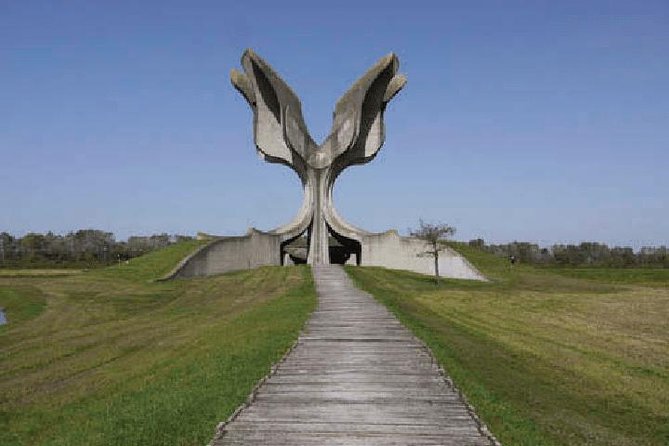
The final major stop is the Jasenovac Memorial and Museum area, connected to the World War II extermination camp operated by the Ustaše regime. The camp held, forced into labor, and murdered large numbers of Serbs, Jews, and Croats who opposed the regime.
The stop is described as an emotional reminder of what racial and national exclusion can lead to. The guide provides a memorial visit, but the standard experience views the camp from outside. An interior museum visit is possible only by request and through a customized itinerary.
You have about 30 minutes here. That is enough for a guided introduction and a moment of reflection, but it is not a full museum study. This is an important distinction when deciding if the tour suits you. If you want detailed Holocaust and World War II interpretation, you may need to arrange the customized option or make a separate visit.
Jasenovac also changes the tone of the day. Travnik and Jajce are visually rewarding and often photogenic. Jasenovac is solemn. I consider that contrast a strength, provided you are prepared for a serious final stop rather than expecting the day to end with light sightseeing.
What the $161.95 price really covers
At $161.95 per person, this is not the cheapest way to move between Sarajevo and Zagreb. You are paying for the transfer, a driver-guide, hotel pickup, a small group, and several included admissions.
The listed entrance fees cover:
- Travnik Fortress, 2 euros
- Jajce Fortress, 2.5 euros
- Jajce Catacombs, 2.5 euros
- AVNOJ Museum, 1 euro
The Banja Luka guided tour and guided Jasenovac visit are also included. Those additions make the price easier to justify than a simple bus ticket, especially if you would otherwise pay for separate local transport and admissions.
The value depends on how you would spend the route without this service. If you only need to reach Zagreb or Sarajevo as cheaply as possible, public transport will likely be the better choice. If you want to see inland Bosnia without renting a car, the cost buys you access to several places in one day.
The tradeoff is time. You pay in money, but you also pay with a long day and repeated short visits. This is a good use of time if you have limited days in Bosnia. It is less appealing if you prefer two or three nights in each town.
Who should book this road tour
I would recommend it to you if you are already planning to travel between Sarajevo and Zagreb and want the journey to carry some sightseeing value. It suits first-time visitors who want a broad introduction to north-central Bosnia without managing complicated connections.
It is also a strong choice for history-focused visitors. The route covers Ottoman Bosnia, medieval fortifications, socialist Yugoslavia, World War II atrocities, and the 1992 to 1995 war’s impact on cultural sites. Few transfer days offer that range.
The small group is helpful for solo visitors, couples, and anyone who wants a more personal feel than a large coach. Hotel pickup also removes the need to find an early morning meeting point, though the exact pickup arrangements depend on the selected direction and booking confirmation.
I would hesitate if you need a slow pace, long meals, or lots of free time. You should also think carefully about the Jasenovac visit. It is handled as an outside memorial stop in the standard plan, and the subject matter is heavy.
Free cancellation is available up to 24 hours before the start time. Confirmation is sent within 48 hours, subject to availability. Service animals are allowed, and most people can participate. Public transportation is nearby, although hotel pickup is offered.
Should you book it?
Book this tour if you want an efficient, scenic transfer with real historical depth. The strongest reasons are the small group, included admissions, Jajce’s unusual combination of waterfall and medieval monuments, and the chance to visit Banja Luka and Jasenovac without arranging separate transport.
Skip it if your priority is the lowest fare or a short, direct journey. The 7:30 am start and 10 to 12-hour schedule require stamina, and the sightseeing time at each stop is limited.
For most people choosing between a complicated self-arranged route and a guided day across Bosnia, this is the more rewarding option. Just treat it as a full touring day that ends with a transfer, not as a simple ride from one capital to another.
FAQ
Is this tour one way from Sarajevo to Zagreb?
Yes. You can book a one-way transfer from Sarajevo to Zagreb or choose the reverse direction from Zagreb to Sarajevo.
What time does the tour start?
The stated start time is 7:30 am.
How long does the transfer take?
The experience lasts approximately 10 to 12 hours. A previous Zagreb to Sarajevo journey began at 7:30 am and arrived around 8 pm.
What attractions are included?
The route includes Travnik Fortress, Šarena Džamija, the Pliva Waterfall, the AVNOJ Museum, Jajce Catacombs, Bear Tower, the Belfry of St. Luke, Banja Luka, the Vrbas River canyon, and the Jasenovac memorial area.
Are entrance fees included?
Yes. Admission to Travnik Fortress, Jajce Fortress, Jajce Catacombs, and the AVNOJ Museum is included. The Banja Luka guided tour and guided Jasenovac visit are also included.
Is lunch included?
No. Lunch is not included in the price.
How many people can join the tour?
The experience is offered as a small-group transfer. It is described as capped at seven people in the highlights, while the additional information lists a maximum of eight travelers.
Just added around Sarajevo
- Private Full Day Safari Tour★ 5.0 · 8 reviews
- Sarajevo Under Siege: A War History Tour★ 5.0 · 10 reviews
- Travnik, Jajce, Pliva Lakes & Mills –Medieval & Ottoman Bosnia Full Day Tour★ 5.0 · 3 reviews
- Mysterious Visoko Pyramids Driving and Walking Tour★ 5.0 · 7 reviews
- Walking Tour in Sarajevo★ 5.0 · 3 reviews
- Secret Tito’s Bunker/Konjic Tour★ 5.0 · 4 reviews
- Tour of Herzegovina – From Sarajevo★ 5.0 · 3 reviews
- Sutjeska National Park Hike from Sarajevo★ 5.0 · 8 reviews
Private Drivers, compared.
Sarajevo to/from Dubrovnik Transfer Tour via Mostar & Herzegovina
Read our review →
Sarajevo to Belgrade: Transfer With East Bosnia Tour
Read our review →
Sarajevo to/from Belgrade UNESCO Transfer Day Tour (Fees Incl.)
Read our review →
Sarajevo to Split (or opposite): Transfer With Herzegovina Tour
Read our review →
Transfer Mostar to Dubrovnik with Kravice Waterfalls, Blagaj and Počitelj tour
Read our review →
Sarajevo to Dubrovnik: Transfer With Herzegovina Tour
Read our review →Browse the lists this tour appears in