
Reviewed · WALKING TOURS
Sarajevo Essential Full Walking Tour
Sarajevo’s story is told in a few city blocks. On this walk, you pass a Catholic cathedral, an Ottoman mosque, a covered bazaar, an Orthodox church, and the bridge linked to the assassination that helped trigger the First World War. That tight mix makes the tour a useful first look at the city’s past and present.
I like the compact route, which covers many major sights without asking you to spend half a day on your feet. I also like the chance to see Sarajevo’s working craft tradition on Kazandziluk, where coppersmiths still practice their trade. The main consideration is group size: the tour is described as small-group, but the maximum can reach 50 people, so the experience may not always feel intimate.
Key points at a glance

- Sixteen stops in about one to two hours: You cover Sarajevo’s main religious, cultural, historic, and wartime sights at a brisk pace.
- A rare mix of faiths in one walk: Catholic, Muslim, Jewish, and Orthodox landmarks appear within a compact central area.
- The guide adds the local frame: Guides explain customs, city life, and details that are easy to miss when you walk alone.
- Kazandziluk keeps the route grounded: This is not only a monument tour. You also see Sarajevo’s living copper trade.
- The price is easy to justify: At $18.15, the walk offers a useful orientation before you explore on your own.
- Ado has made a strong impression: If he leads your walk, expect an educated, easy-to-follow presentation and room for questions.
Why this short Sarajevo walk works
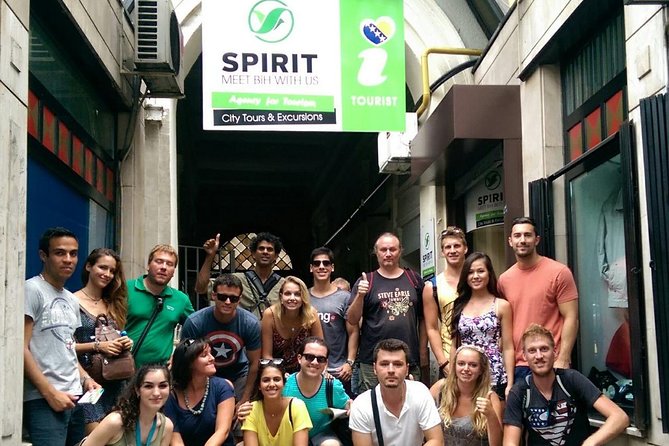
Sarajevo can feel confusing at first because its central streets shift quickly from Austro-Hungarian buildings to Ottoman lanes. The Sarajevo Essential Full Walking Tour gives you a clear thread through that change. You begin near Ferhadija Street and finish where you started at the Spirit Tours office, covering the old town and nearby central sights on foot.
The route is not just a checklist of buildings. Its real value is the way the stops fit together. The Sacred Heart Cathedral, Gazi Husrev-Bey Mosque, Emperor’s Mosque, and Cathedral Church of the Nativity of the Theotokos show how several religious communities shaped Sarajevo. The Sarajevo Meeting of Culture then makes that point physical: one side of the street feels Central European, while the other leads toward the Ottoman heart of Baščaršija.
At $18.15 per person, I consider this a good-value introduction. You are paying for a local guide, a planned route, and context at more than a dozen places. You are not paying for food, drinks, or entry to the Museum of the Jews of Bosnia and Herzegovina or Sarajevo City Hall, so budget separately if you want to go inside.
The pace matters. Sixteen stops in roughly one to two hours leaves little time for long visits. Think of this as an orientation walk rather than a series of full museum tours. You will see where each place is, learn why it matters, and then decide which ones deserve a longer return visit.
A few more things to do around Sarajevo
- Sarajevo: 2 Hours Old Town Walking Tour With Local Guide
★ 5.0 · 505 reviews - Private Walking Tour, Food Tasting and Bosnian Coffee in Sarajevo
★ 5.0 · 255 reviews - Sarajevo Grand Walking Tour
★ 5.0 · 232 reviews
From Sacred Heart Cathedral to Sarajevo’s religious crossroads
The tour opens at the Cathedral of Jesus’ Sacred Heart, Sarajevo’s largest Catholic church. Built in 1889 in Neo-Gothic style, it serves as the seat of the Archdiocese of Vrhbosna. The planned ten-minute stop gives you enough time to take in the facade and understand the role of the Austro-Hungarian period in shaping the city center.
From there, the route reaches the Museum of the Jews of Bosnia and Herzegovina, located inside the city’s oldest synagogue. The stop is only about five minutes, and admission is not included. That short visit is useful mainly as a signpost to Sarajevo’s Jewish past. If you want a fuller museum visit, you will need to return with extra time and pay the entry fee yourself.
The Sarajevo Meeting of Culture comes next. A marker on Ferhadija Street identifies the point where two major cultural zones meet. This is one of the tour’s best orientation stops because it helps you notice a change in street design, buildings, shops, and atmosphere without needing a long lecture.
The route then enters the Ottoman center at Gazi Husrev-Bey Mosque. Built in the 16th century, it is the largest historic mosque in Bosnia and Herzegovina and one of the most important Ottoman buildings in the Balkans. The ten-minute stop is enough for a first look, though visitors should remember that a mosque remains a place of worship, not simply a sightseeing site. Dress and behavior should be respectful.
Baščaršija, the Sebilj Fountain, and copper craft
Baščaršija gives the walk its strongest sense of place. At its center, the Sebilj is an Ottoman-style wooden fountain built in 1753 by Mehmed Pasha Kukavica. The five-minute stop is brief, but the fountain is an easy meeting point and a useful symbol of the old market quarter.
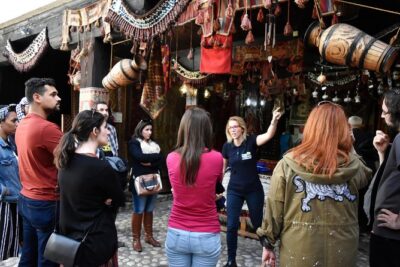
Kazandziluk is more than a pretty lane. It is the coppersmith street, where the traditional craft still continues. The street has retained its old appearance for centuries, and this is one of the most enjoyable stops because you see an occupation rather than only a preserved building.
A particularly good detail from the tour experience is the chance to enter a coppersmith’s shop and look at examples of decorated metalwork. That makes the craft easier to understand than a quick glance through a shop window. If you enjoy handmade goods, this is also the natural place to consider buying a small item, though food and drinks are not part of the tour.
The route can feel quick here. Ten minutes does not allow much time for browsing, conversation, and photographs, especially if the group is large. I would treat Kazandziluk as a preview and return later if the craft catches your interest.
Sarajevo City Hall and the Spite House
Sarajevo City Hall, known as Vijećnica, marks another change in the city’s architecture. It was the most extravagant building constructed in Sarajevo during the Austro-Hungarian occupation and is presented as a symbol of the meeting of world civilizations.
The tour allows about ten minutes at the building, but admission is not included. That distinction matters. You will see the exterior and receive the guide’s explanation, but an interior visit requires a separate ticket and additional time. If the building is high on your list, plan a return visit rather than trying to squeeze it into this fast walk.
Nearby, the route crosses the Cumurija Bridge and points out the Spite House. The story is simple and memorable: the owner resisted the city’s plans, and the house became known for that stubbornness. It is now a protected cultural and historical site and a national restaurant.
This stop adds a bit of humor to a route that includes war, empire, and religious history. It also shows how local character often survives in small stories attached to ordinary-looking buildings. You get five minutes here, enough to hear the tale and take a look, but not enough for a meal.
Same base, a different kind of day out:
- Sarajevo: Mostar, Konjic, Blagaj Tekke, Pocitelj & Waterfall
★ 4.9 · 1,335 reviews - Fall of Yugoslavia, Sarajevo War Tour with Tunnel of Hope Museum and Frontlines
★ 5.0 · 1,314 reviews - Sarajevo: Mostar, Konjic, Sufi House, Pocitelj & Kravice Falls
★ 5.0 · 1,179 reviews - ROSES OF SARAJEVO (Official WAR + CITY tour)- Story of a Survivor
★ 5.0 · 770 reviews
Emperor’s Mosque and the Ottoman foundation of Sarajevo
The Emperor’s Mosque is described as Sarajevo’s oldest mosque and one of the oldest in Bosnia and Herzegovina. It is believed to have been built soon after Sarajevo’s founding in 1462 by Isa Bey Ishaković, in honor of Sultan Mehmed II, known as the Conqueror.
This stop helps place Gazi Husrev-Bey Mosque in a wider story. Gazi Husrev-Bey expanded and shaped the city in the 16th century, while the Emperor’s Mosque connects to Sarajevo’s earlier foundation. You do not need to know every name before the tour begins. The guide’s job is to connect these monuments so the Ottoman part of the city does not blur into a row of attractive old buildings.
The mosque stop lasts about five minutes. That is enough for an introduction, but not a detailed visit. As with any active religious building, follow the guide’s instructions and observe local customs.
Latin Bridge and the event that changed Europe
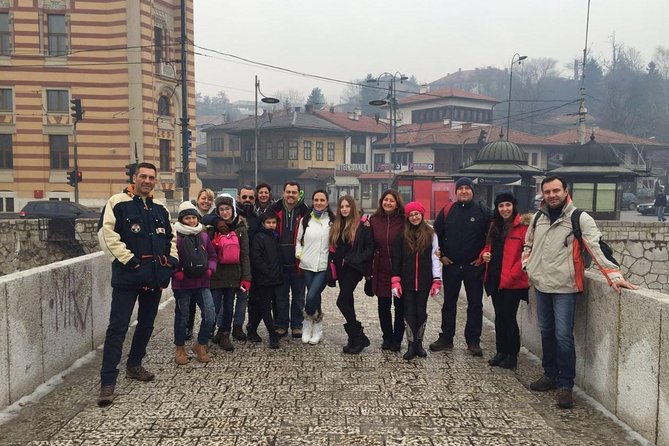
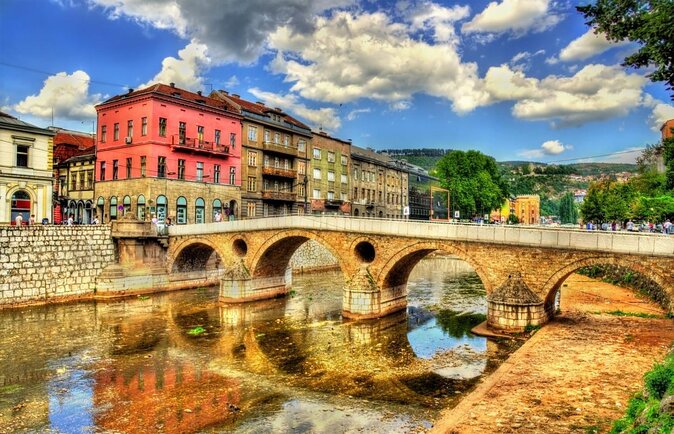
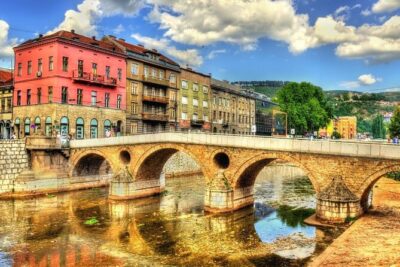
Latin Bridge is one of the most important stops on the route. It is linked to Gavrilo Princip’s assassination of Archduke Franz Ferdinand and his wife, Sophie. The Sarajevo assassination helped set off the First World War, so this modest bridge carries importance far beyond its size.
The tour gives you about ten minutes here. That is a sensible amount of time for the guide to explain the location and the chain of events, while leaving room for questions. The site is valuable because it turns a familiar history-book event into a precise place you can stand beside.
I appreciate that the stop is part of a broader city walk rather than the whole focus of the tour. Sarajevo is not only the place where the First World War began. The route places Latin Bridge beside mosques, markets, churches, and daily city life, which gives you a more balanced understanding of Sarajevo.
Bezistan, Tašlihan, and Hotel Europe
Gazi Husrev-Bey’s Bezistan is a covered bazaar built in 1555. It still serves its original basic purpose as a place for trade. The five-minute stop lets you see how the Ottoman commercial center was organized and how buying and selling remain part of the old town’s identity.
Nearby, Tašlihan recalls another part of the same period. Built in 1543 as part of Gazi Husrev-Bey’s charitable foundation, it once included a fountain, mosque, courtyard, shops, and storage rooms. Fires badly damaged it, so what you see today is more fragment than complete building.
That contrast is useful. The Bezistan shows continuity, while Tašlihan shows how much of the old city has been lost or altered. You get a quick explanation rather than a full archaeological visit.
The route then reaches Hotel Europe, an Austro-Hungarian building close to the old town. Its exterior offers another reminder that Sarajevo’s center was shaped by more than one empire. The five-minute stop is mostly visual, but it fits well with the earlier visit to the cathedral and the Sarajevo Meeting of Culture.
The Orthodox cathedral and the multicultural monument
The Cathedral Church of the Nativity of the Theotokos is Sarajevo’s largest Serbian Orthodox church and one of the largest in the Balkans. Its presence near the Catholic cathedral and Muslim landmarks gives the route a strong geographic lesson: Sarajevo’s religious communities are not separated into distant suburbs. Their major buildings sit close together in the center.
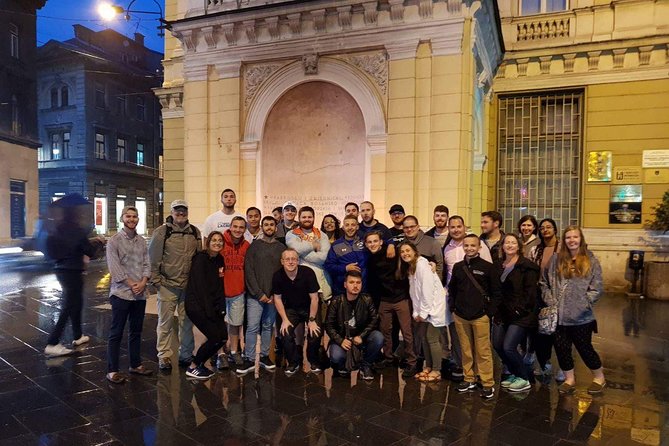
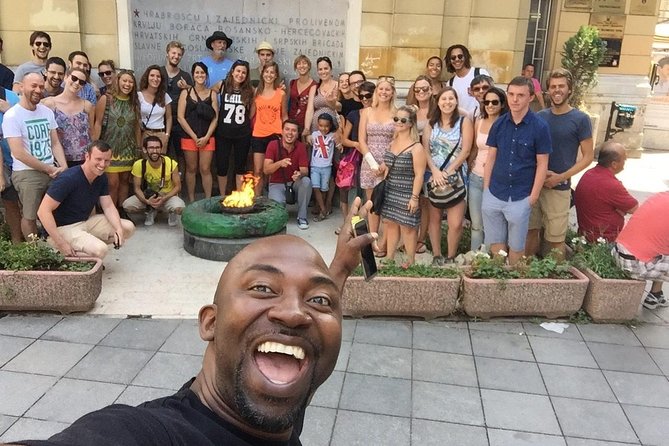
The Monument to the Multiethnic Human makes that point directly. It is positioned between the Catholic cathedral, Muslim mosque, and Orthodox church. Its message, carved in Italian and Bosnian, says that the multicultural person constructs the world.
This may feel like a simple photo stop, but it gives the guide a chance to explain the city’s identity in plain terms. Sarajevo’s multicultural past is not an abstract theme. You can see the physical closeness of these traditions within a few minutes of walking.
The ten-minute stop is longer than most of the religious landmarks, which makes sense. It is a place for the guide to connect the earlier stops and explain why Sarajevo is often described as a meeting point between cultures.
Sarajevo Roses and the city’s recent scars
The final stop is a Sarajevo Rose. These memorials mark concrete scars left by mortar explosions. The damage was later filled with red resin, creating a flower-like shape on the pavement.
This is a small but powerful way to end the walk. You have just seen imperial buildings, mosques, churches, markets, and bridges. The Sarajevo Rose brings the story into the recent past and reminds you that the city’s streets carry memories from the war as well as from earlier centuries.
The ten-minute stop gives the guide time to explain what you are seeing without turning the whole tour into a wartime history lesson. If you want extensive information about the siege of Sarajevo, this tour may only be a starting point. Its strength is showing how that memory remains part of ordinary streets.
Group size, guide style, and the walking pace
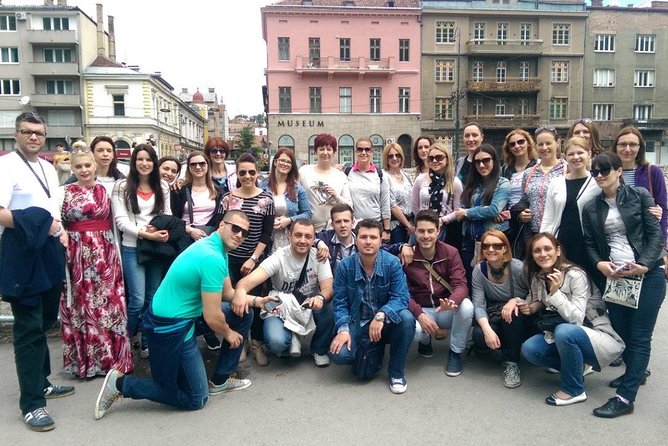
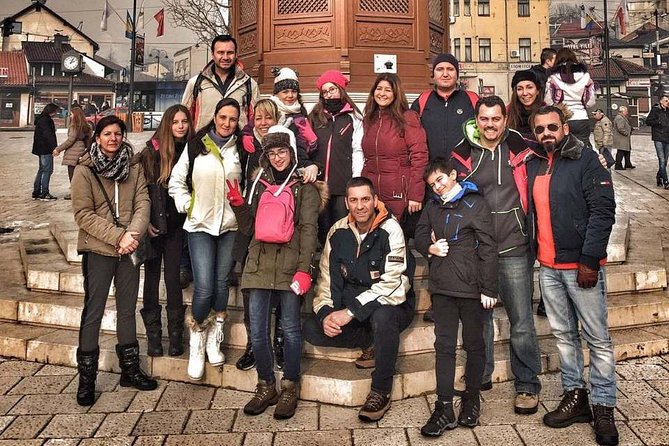
The experience includes a local professional guide and is offered in English. A past tour led by Ado was especially strong because he explained the city clearly, spoke with authority, and made time for questions. If Ado leads your group, you can expect an easy-to-follow presentation with room for conversation.
The advertised format is small-group, but the stated maximum is 50 people. That is a significant difference. A group of two or ten may feel conversational, while a group near the maximum will be less personal and may make it harder to hear or ask questions.
The pace is brisk. You will cover 16 stops in about one to two hours, and the stop times range from five to ten minutes. Wear comfortable shoes and arrive ready to keep moving. Pickup can be arranged in advance from a hotel, apartment, or hostel, but the regular meeting point is the Spirit Tours office at Ferhadija 19.
The tour operates Monday through Sunday from 9:00 a.m. to 5:00 p.m. Confirmation is provided at booking, service animals are allowed, and the meeting point is near public transportation. Most people can participate, but the supplied information does not describe the route’s surface, slopes, or accessibility in detail.
Who should book this Sarajevo tour?
I would choose this walk if you have limited time in Sarajevo, want a clear first orientation, or prefer to see the main sights with context before exploring alone. It is also a good fit if the city’s mix of Ottoman, Austro-Hungarian, religious, and wartime history is your main interest.
It suits curious first-time visitors more than people seeking long interior visits. The two paid entries, the Jewish Museum and City Hall, are not included, and the tour does not include food or drinks. You should also choose it with realistic expectations about group size and pace.
The tour requires a minimum number of participants. If that number is not reached, you can be offered another date or experience, or receive a full refund. Cancellation is free up to 24 hours before the start time, but changes or cancellations inside that window are not refunded.
Should you book it?
Yes, if you want an affordable, efficient introduction to Sarajevo’s central story. The best parts are the close sequence of religious landmarks, the stop on Kazandziluk, Latin Bridge, and the guide’s ability to connect separate sights into one understandable route.
I would not book it as your only Sarajevo experience. The short timing means you will get an overview, not a full museum visit or a slow study of each monument. At $18.15, though, it is a sensible first walk, especially if you plan to return to Vijećnica, the Jewish Museum, or the craft street afterward.
FAQ
Where does the Sarajevo Essential Full Walking Tour start?
The standard meeting point is the Spirit Tours office, Spirit Tours Ferhadija 19, Sarajevo 71000, Bosnia and Herzegovina.
Where does the tour end?
The activity ends back at the meeting point.
Can I arrange pickup from my accommodation?
Yes. Hotel, apartment, or hostel pickup can be arranged in advance if required.
How long does the tour last?
The tour lasts approximately one to two hours.
What language is the tour offered in?
The tour is offered in English.
What is included in the price?
A local professional guide is included.
Are food and drinks included?
No. Food and drinks are not included.
Is admission to Sarajevo City Hall included?
No. Admission to Sarajevo City Hall is not included.
Is admission to the Museum of the Jews of Bosnia and Herzegovina included?
No. Admission to the Museum of the Jews of Bosnia and Herzegovina is not included.
What is the cancellation policy?
You can cancel at least 24 hours before the start time for a full refund. Cancellations or changes made less than 24 hours before the start time are not refunded.
Just added around Sarajevo
- Downhill Sarajevo MTB Mountain Biking Adventure on Trebevic – Half Day Tour★ 5.0 · 3 reviews
- Sarajevo War Tour with TRAVELPLUS★ 5.0 · 11 reviews
- Skakavac Waterfall Mountain Biking Tour from Sarajevo MTB★ 5.0 · 11 reviews
- Sarajevo: Private Transfer to and from Sarajevo Airport★ 5.0 · 19 reviews
- From Sarajevo: Visoko And Bosnian Pyramid Mistery★ 5.0 · 18 reviews
- Bosnian Traditional Handicraft, half-day – do it yourself – Coppersmith Workshop★ 5.0 · 13 reviews
- Hiking Prenj, Velika Kapa★ 5.0 · 14 reviews
- Three day Tara River Rafting and Jeep Safari Durmitor Tour★ 5.0 · 12 reviews
Walking Tours, compared.
Private Walking Tour, Food Tasting and Bosnian Coffee in Sarajevo
Read our review →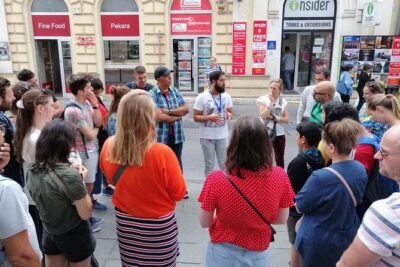
Delicious Sarajevo: Eat, Walk & Discover City Tour
Read our review →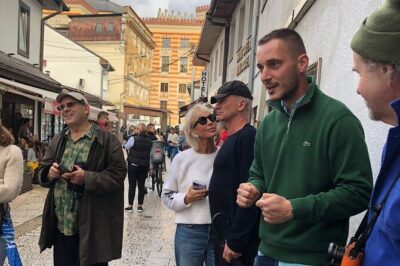
PROFESSIONAL SARAJEVO WALKING TOUR – With guide who guided STING!
Read our review →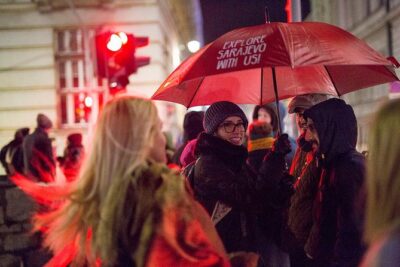
Browse the lists this tour appears in