
Reviewed · FOOD & DRINK
Private Walking Tour, Food Tasting and Bosnian Coffee in Sarajevo
Sarajevo’s story is packed into a short walk: Ottoman bazaars, Austro-Hungarian buildings, places of worship, wartime memories, and the bridge linked to the start of World War I. This private tour brings those pieces together with Bosnian food and coffee, so you get more than a sightseeing circuit.
I like the personal format and the way the route connects different faiths and empires in a small area. I also like that guides such as Emina and Lamija add local advice and explain customs, not just dates. The main consideration is time: two and a half hours goes quickly, and several stops are brief rather than full museum visits.
Key points at a glance
- Coffee is part of the lesson: You learn how Bosnian coffee is prepared and drunk, then taste it in a former Ottoman caravanserai.
- The route crosses Sarajevo’s major cultural layers: Ottoman, Austro-Hungarian, Islamic, Catholic, and Orthodox landmarks all appear within one walk.
- Food is more than a token sample: The meal includes traditional Bosnian dishes and sweets, with portions described as generous.
- A private guide changes the pace: Your group has the guide’s full attention, and you can ask questions about Sarajevo, Bosnia, and later plans.
- History appears in ordinary streets: The route covers Sarajevo roses, converted shell casings, the assassination of Franz Ferdinand, and the city’s unusual clock.
- The price reflects the format: At $66.54 per person, the tour costs more than a large group walk, but includes private guiding, food tasting, and coffee.
Why this Sarajevo walk works so well
The best feature here is the combination of walking and eating. Sarajevo’s old center is compact, but its story is not simple. You move from an Ottoman market street to an Austro-Hungarian cathedral, then to a mosque, an Orthodox cathedral, and the bridge connected with the assassination of Archduke Franz Ferdinand.
A guide gives those places a human thread. Instead of seeing separate buildings, you learn how Sarajevo grew as a meeting point of cultures and religions. The food breaks up the history in a useful way. You can stop, taste something local, and talk through what you have just seen.
The private setup suits anyone who prefers conversation over a scripted speech. Emina and Lamija are named as guides associated with the experience, and the guiding style is warm and personal. One guide even provided an extra umbrella during rainy weather, a small detail that matters when you are on foot.
The tour is offered in English and lasts about 2 hours and 30 minutes. It begins at Sarajevo City Hall, on Brodac, and finishes at a different location near the final sights. Since the exact route includes many short stops, wear comfortable shoes and arrive ready to walk rather than expecting long indoor visits.
A few more things to do around Sarajevo
- Sarajevo Uncovered: Old Town Tour with Coffee and Food Tasting
★ 5.0 · 12 reviews
Sebilj and the first taste of Baščaršija
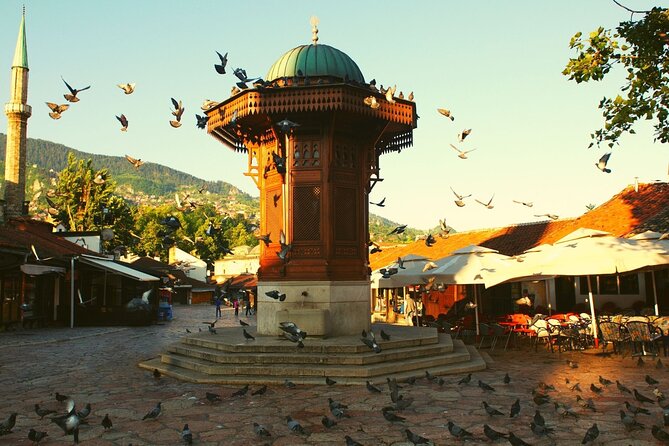
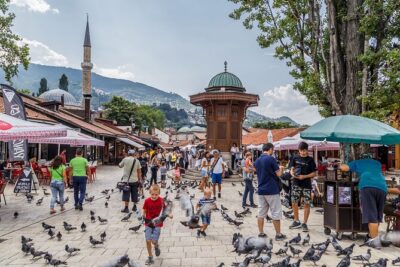
The route includes Sebilj, the wooden fountain on Baščaršija’s Pigeon Square. This 18th-century fountain is one of Sarajevo’s most recognizable meeting points, and it gives your guide a natural place to explain the city’s beginnings and Bosnia’s changing rulers.
The square is a good introduction because it immediately places you in the old market quarter. You can look at the fountain, the surrounding lanes, and the craft shops while hearing how Sarajevo developed around trade, religion, and daily life.
The scheduled stop lasts about 25 minutes. That is enough time for orientation and questions, but not enough for a detailed survey of every lane around the square. If you want photographs without rushing, arrive a few minutes early.
Sarajevo City Hall and the Austro-Hungarian chapter
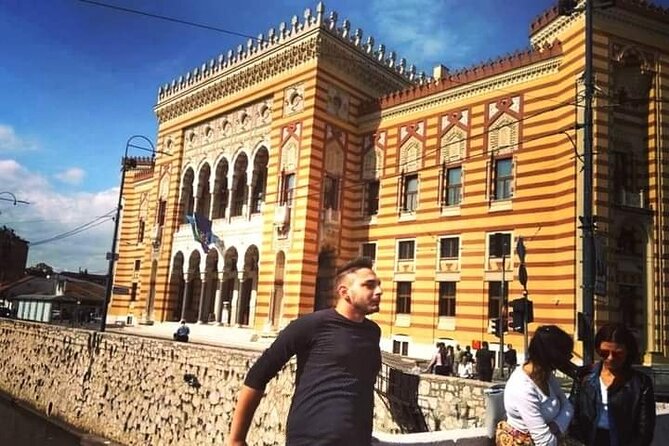
Sarajevo City Hall is one of the city’s most striking Austro-Hungarian buildings. Its design is ornate and formal, a sharp contrast with the smaller Ottoman-era shops nearby. The building also served as the National and University Library, adding another layer to its importance.
Because the tour starts at City Hall, you begin with a building that helps explain Sarajevo’s transition into the Austro-Hungarian period. Your guide can then set that period beside the Ottoman character of Baščaršija.
The listed stop is about 10 minutes, so this is mainly an exterior introduction rather than a long architectural visit. That is useful if you want a broad first-day orientation, but less satisfying if your main interest is detailed building history.
Kazandžiluk, copperwork, and the meaning of coffee
Kazandžiluk is known as Sarajevo’s oldest street and the center of its coppercraft tradition. The narrow lane offers one of the clearest links between the old market and living local work. You see objects made for use, decoration, and gifts, rather than only preserved historic buildings.
The coffee discussion begins here. Your guide explains why coffee matters in Bosnian tradition and shows how traditional Bosnian coffee is made and served. This is a valuable part of the tour because coffee is not treated as a quick drink between attractions. It becomes a window into hospitality and social customs.
A particularly memorable detail is the work of a local metal craftsman who turns mortar shell casings into vases. That change from a weapon into a household object gives the craft a quiet meaning without needing a long speech.
You have about 10 minutes at Kazandžiluk, so do not expect a full shopping session. If you see a copper piece you like, ask your guide where to look and how to judge the workmanship.
Same base, a different kind of day out:
- Sarajevo: Mostar, Konjic, Blagaj Tekke, Pocitelj & Waterfall
★ 4.9 · 1,335 reviews - Fall of Yugoslavia, Sarajevo War Tour with Tunnel of Hope Museum and Frontlines
★ 5.0 · 1,314 reviews - Sarajevo: Mostar, Konjic, Sufi House, Pocitelj & Kravice Falls
★ 5.0 · 1,179 reviews - ROSES OF SARAJEVO (Official WAR + CITY tour)- Story of a Survivor
★ 5.0 · 770 reviews
Morica Han and the proper Bosnian coffee ritual
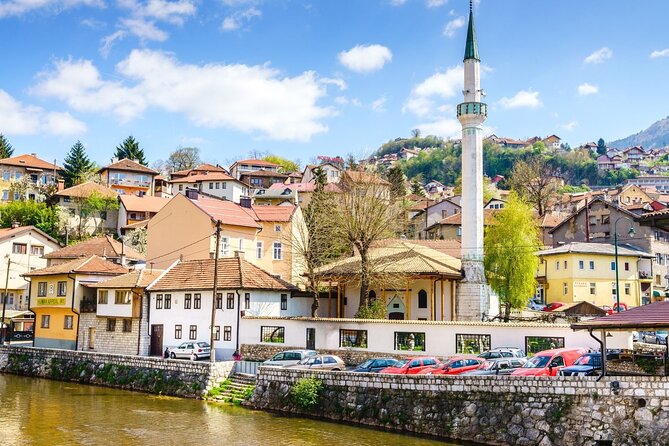
Morica Han is one of the tour’s strongest historical stops. This former medieval caravanserai recalls the Ottoman trading world, when merchants and pack animals needed a place to rest during long journeys.
Here you taste Bosnian coffee in a traditional setting. The ritual is different from simply ordering a brewed cup. Your guide shows you how to approach it, and you get a chance to ask questions while sitting with the custom rather than just hearing about it.
The stop lasts around 25 minutes, giving it more room than several of the architectural stops. I like that balance. You have enough time to taste, talk, and notice the setting.
Bosnian coffee can be intense and is traditionally served with the grounds remaining in the pot or cup. Follow the guide’s instructions and avoid drinking the final gritty mouthful. The point is not to rush through it. Treat it as a short pause in the walk.
Bravadžiluk and the food portion of the tour
Bravadžiluk Street is known for restaurants serving Bosnian food. This is where the guide recommends traditional dishes and sweets, and where the food tasting becomes the main event.
The exact menu is not fixed in the supplied details, so you should not book this expecting a guaranteed list of named dishes. You can expect traditional savory food and sweets, and the meal may take place at a small cafe or local restaurant. Portions have been described as large, which makes the $66.54 price easier to assess if you would otherwise pay separately for lunch.
I like the practical value here. A guide can explain what to order later in your trip and point you toward foods that may be unfamiliar. You also avoid the common first-day problem of choosing a restaurant at random in a historic center.
The stop itself is listed as only about three minutes, which likely means the street is an orientation point rather than the full dining time. Expect the food experience to be woven into the route rather than measured by that single short entry.
The clock tower and Sarajevo’s unusual time
Near one of Sarajevo’s notable mosques, the Old Sarajevo Clock Tower shows a very unusual time. Its story is tied to the traditional way of marking the day, and the guide explains why its display differs from the clocks you normally see.
The official stop is only about two minutes. That tells you what to expect: a quick look and a memorable explanation, not a climb or an extended visit inside the tower. It is a small stop, but it gives the walk character.
Cathedral, Sarajevo roses, and memories of war
The Sacred Heart Cathedral brings you into the Austro-Hungarian religious and architectural story. Built in a Neo-Renaissance style, it is an imposing Catholic church in the center of a city often described through its religious mix.
The route also includes the statue of Pope John Paul II and a discussion of Sarajevo roses. These red markings recall places where mortar explosions caused deaths during the siege of Sarajevo. They are easy to pass without understanding, so having a local guide explain them makes the street itself more meaningful.
This stop lasts about 10 minutes. The subject matter can be heavy, and the tour does not appear to be a dedicated siege-history walk. If you want extensive wartime background, you will need a separate museum or longer specialist tour. For a general city walk, this is a useful and respectful introduction.
Gazi Husrev-beg Mosque and the Ottoman center
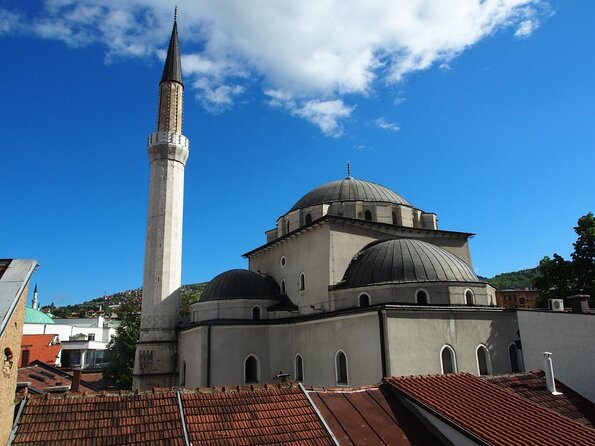
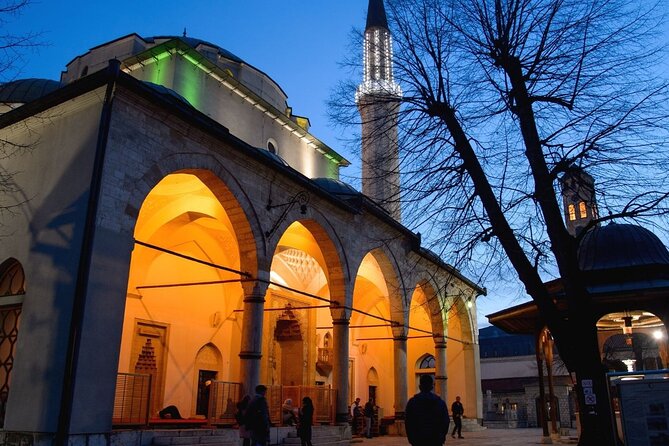
Gazi Husrev-beg Mosque is one of Sarajevo’s most important Islamic buildings and one of the central sights in the old quarter. The tour takes you to the mosque and also includes Gazi Husrev Bey’s Bezistan, an old Ottoman bazaar.
Together, these stops help you understand how the Ottoman city was organized. The mosque was not an isolated monument. Around it were commercial spaces, streets, markets, and places where people met and worked.
The mosque stop lasts about 10 minutes, with another short visit around the Bezistan. Dress and behavior should be respectful at any religious site. The supplied information does not specify interior access, so plan on an exterior explanation unless your guide tells you otherwise.
This is one of the places where the private format pays off. You can ask about customs, architecture, and the role of the mosque in Sarajevo without worrying about holding up a large group.
Latin Bridge and the event that changed Europe
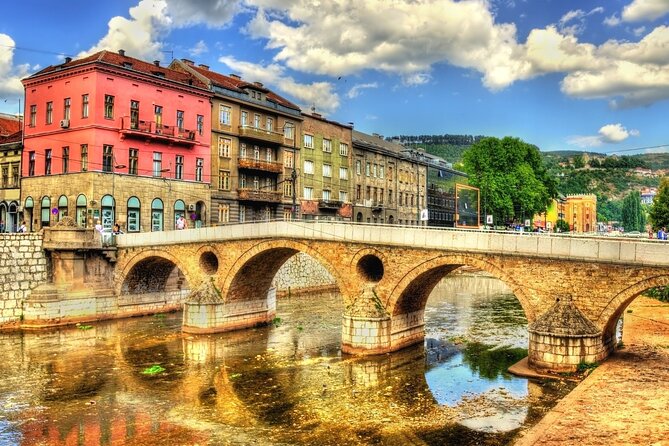
The tour finishes near Latin Bridge, associated with the assassination of Franz Ferdinand. The event took place here in 1914 and helped set off the chain of events that became World War I.
The value of this stop lies in the connection between a modest bridge and a huge turning point. Your guide can explain what happened at the site and place the assassination in the wider story of Sarajevo and the Austro-Hungarian Empire.
The visit is scheduled for about 10 minutes. That gives you time to see the bridge and hear the essential story, but not to explore every argument surrounding the event. It is an effective ending because the route finishes with a moment that connects Sarajevo to wider European history.
Serbian Orthodox Cathedral and the city’s religious mix
The Cathedral of the Nativity of the Theotokos is described as Sarajevo’s largest Orthodox church. Its architecture and construction add another religious and cultural chapter to the walk.
The stop lasts about five minutes, so it is brief. Still, placing the Orthodox cathedral near the Catholic cathedral, mosque, bazaar, and other old-city sights gives you a clear sense of Sarajevo’s close-knit religious geography.
This is one reason I would take the tour early in a Sarajevo visit. It gives you a map of the center, then leaves you better prepared to return to the buildings that interest you most.
What $66.54 buys you
At $66.54 per person, this is not the cheapest way to see Sarajevo. You are paying for a private activity, an English-speaking guide, food tasting, and Bosnian coffee, not just a walk past the main sights.
The value is strongest for couples, families, or a small group that wants flexibility and conversation. A private guide can adjust explanations to your interests and offer suggestions for the rest of your stay. Emina and Lamija are specifically praised for clear explanations, friendly conversation, and useful advice about what to see and do in Bosnia.
The value is weaker if you only want a fast orientation or if you already know Sarajevo’s old center well. The route covers many stops, but most are short. You may prefer a self-guided walk if food and personal instruction are not important to you.
The tour is booked an average of 28 days ahead, so early planning is sensible if your dates are fixed. Confirmation is provided at booking, and free cancellation is available up to 24 hours before the start time. If the minimum number of participants is not reached and the activity is canceled, you are offered another date or a full refund.
Who should book this private walk?
I would recommend it for a first visit to Sarajevo, especially if you want food advice, a quick grasp of the city’s past, and a comfortable introduction to Bosnian coffee. It also fits well for solo visitors and small groups who like asking questions as they walk.
Families and older visitors who can manage a normal city walk may appreciate the private pace, though the route includes several short stops and historic streets rather than a seated sightseeing format. Most people can participate, and service animals are allowed.
I would choose something else if your priority is a long museum visit, a dedicated war-history tour, or a fixed culinary menu with named dishes. This experience is broad by design. It gives you a strong first look at Sarajevo, then helps you decide where to spend more time.
FAQ
Where does the tour start?
It starts at Sarajevo City Hall, at Brodac 1 in Sarajevo.
Where does the tour end?
The activity ends at a different location from the starting point. The route finishes near Latin Bridge and also includes the Serbian Orthodox Cathedral.
How long does the tour last?
The tour lasts approximately 2 hours and 30 minutes.
Is the tour private?
Yes. Only your group participates in the private activity.
What language is offered?
The tour is offered in English.
Is food included?
Food tasting is part of the experience. You visit Bravadžiluk Street for traditional Bosnian food and sweets, with the tasting taking place at a local cafe or restaurant.
Is Bosnian coffee included?
Yes. You learn how traditional Bosnian coffee is prepared and drunk, then taste it at Morica Han.
What sights are included?
The route includes Sebilj Fountain, Sarajevo City Hall, Kazandžiluk, Morica Han, Bravadžiluk Street, the Old Sarajevo Clock Tower, the Sacred Heart Cathedral, Gazi Husrev-beg Mosque, Gazi Husrev Bey’s Bezistan, Latin Bridge, and the Serbian Orthodox Cathedral.
Can I cancel for a full refund?
You can cancel up to 24 hours before the experience starts for a full refund. Cancellations or changes made less than 24 hours before the start time are not refunded or accepted.
Should you book it?
Book this tour if you want Sarajevo explained through food, coffee, architecture, and personal stories rather than through a list of monuments. The private format, generous food portions, and traditional coffee lesson give it more substance than a basic city walk.
Skip it if you want a slow museum tour or a tightly defined food itinerary. For most first-time visitors, though, the mix is well judged: enough history to give the city meaning, enough tasting to keep the walk lively, and enough local guidance to improve the rest of your stay.
More Food in Sarajevo
- Delicious Sarajevo: Eat, Walk & Discover City Tour
★ 4.5 · 37 reviews - Eat, Pray, Love Tour
★ 4.5 · 32 reviews
More Food & Drink in Sarajevo
- Sarajevo: 4-Hour Food And Craft Tour
★ 5.0 · 70 reviews - LUKOMIR VILLAGE HIKE & TREK TOUR (nature, hike, food & panorama)
★ 5.0 · 11 reviews - Split/Trogir: Mostar and Medjugorje Tour with Wine Tasting
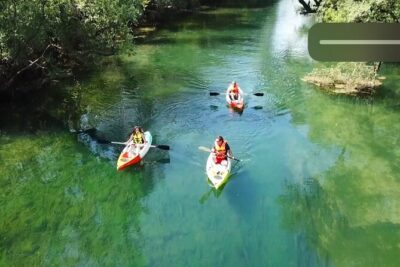
★ 4.5 · 282 reviews - Safari kayak adventure w BBQ & Beer
★ 5.0 · 34 reviews
Just added around Sarajevo
- Downhill Sarajevo MTB Mountain Biking Adventure on Trebevic – Half Day Tour★ 5.0 · 3 reviews
- Skakavac Waterfall Mountain Biking Tour from Sarajevo MTB★ 5.0 · 11 reviews
- Sarajevo War Tour with TRAVELPLUS★ 5.0 · 11 reviews
- Transfer from Sarajevo to Kotor+Herzegovina tour★ 5.0 · 17 reviews
- Sarajevo City SIghtseeing / War Bike Tour★ 5.0 · 13 reviews
- LUKOMIR VILLAGE HIKE & TREK TOUR (nature, hike, food & panorama)★ 5.0 · 11 reviews
- Umoljani Village to Lukomir Village via Obalj Hike from Sarajevo★ 5.0 · 16 reviews
- Trebevic Mountain Biking Tour from Sarajevo – Bobsleigh Track★ 5.0 · 16 reviews
Food & Drink, compared.
Split/Trogir: Mostar and Medjugorje Tour with Wine Tasting
Read our review →
Sarajevo Uncovered: Old Town Tour with Coffee and Food Tasting
Read our review →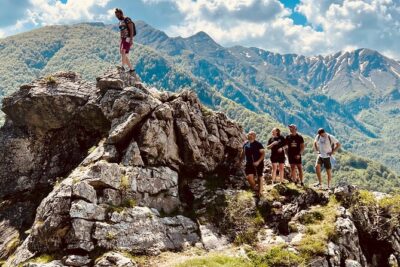
LUKOMIR VILLAGE HIKE & TREK TOUR (nature, hike, food & panorama)
Read our review →Browse the lists this tour appears in