
Reviewed · HISTORICAL TOURS
Sarajevo genuine walking tour: Steps through history
Sarajevo’s story comes into sharp focus on foot, especially where an Ottoman mosque, Orthodox church, Catholic cathedral, and Jewish quarter sit close together. This private tour connects those places with the assassination site beside Latin Bridge, giving you a compact introduction to the city’s layered past.
I like the private format, which lets you ask questions instead of keeping pace with a large group. I also like the route’s religious and cultural range, from Baščaršija’s Ottoman streets to the Jewish Museum and Sacred Heart Cathedral. The main consideration is time: two hours gives you a strong orientation, but visits inside the buildings may be brief.
Key points to know before booking
- Four faith traditions in one walk: The route links Islamic, Orthodox, Catholic, and Jewish sites within Sarajevo’s central old town.
- Private English tour: Only your group takes part, with guides associated with the experience including Sanela and Amilia.
- A clear historical arc: You begin at City Hall, pass through Ottoman Sarajevo, and finish near the site tied to the start of World War I.
- Seven central stops: The walk includes City Hall, Sebilj Fountain, the Old Orthodox Church, Gazi Husrev-beg Mosque, the Jewish Museum, Sacred Heart Cathedral, and Latin Bridge.
- Good value for a short introduction: At $27.61 per person, the price includes a personal guide and free admission at the listed stops.
- Easy booking terms: You can cancel for a full refund up to 24 hours before the start time.
Starting at Sarajevo City Hall and the Spite House
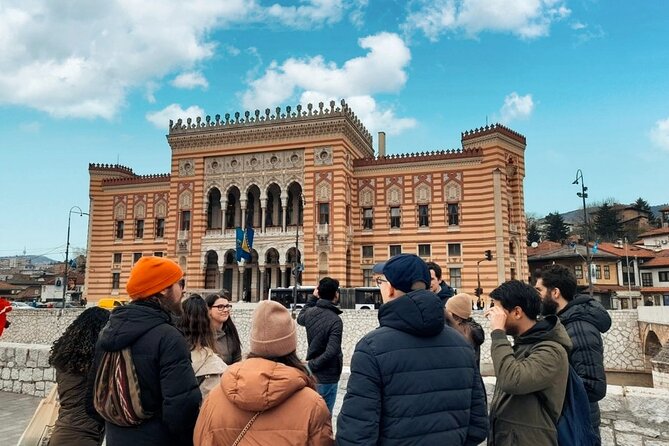
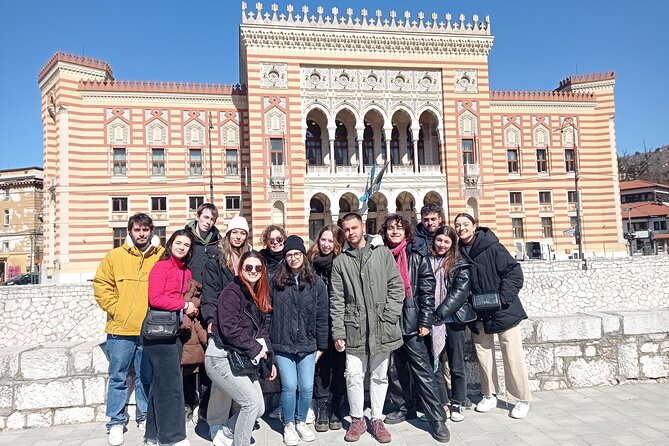
The tour begins at Sarajevo City Hall, on Obala Kulina Bana. This is an excellent starting point because the building immediately shows you that Sarajevo is not only an Ottoman town. Its Pseudo-Moorish design reflects the city’s later Austro-Hungarian period and gives the walk a visual opening far removed from the narrow lanes of Baščaršija.
Allow about 20 minutes here. You can look at the building’s exterior and hear about its role in Sarajevo’s story, including the local legend of the Spite House. That tale adds a human touch to the grand architecture and helps keep the opening from becoming a dry architectural lecture.
The stop is listed as free, so the price of the tour is not being swallowed by admission charges. You should still think of this as an orientation visit rather than a long museum session. The tour has several stops ahead, and the guide needs to keep the group moving.
A few more things to do around Sarajevo
- Sarajevo Full Day Tour: History, Culture, Nature, War & Olympics
★ 5.0 · 27 reviews - SARAJEVO STREET ART TOUR (art, history & mystery) – sARTajevo!
★ 5.0 · 18 reviews - BOSNIAN PYRAMIDS TOUR (nature, history & archeology)
★ 5.0 · 17 reviews
Baščaršija and the Sebilj Fountain
From City Hall, the route heads toward Baščaršija Square and the Sebilj Fountain. This is the visual heart of old Sarajevo, and the fountain is one of the easiest landmarks to recognize in the quarter.
The planned visit takes about 15 minutes. That is enough time for your guide to explain the fountain’s place in Sarajevo’s public life and point out the character of the square. It is also a useful moment to get your bearings before the route turns toward places of worship.
Baščaršija is more than a photo stop. It gives you the physical setting for the Ottoman part of Sarajevo’s story. The square, fountain, and surrounding quarter help explain why the later religious buildings feel connected rather than scattered across an ordinary modern city.
You may want to take photographs here, but keep the group’s pace in mind. This is a walking tour, not an open-ended shopping visit. If you want time to browse the quarter at leisure, plan to return after the tour.
The Old Orthodox Church and Sarajevo’s Christian tradition
The Old Serbian Orthodox Church, dedicated to the Archangels Michael and Gabriel, is one of the oldest houses of worship in Sarajevo. The visit is scheduled for about 10 minutes, so expect a focused explanation rather than an extended stay.
The church’s Byzantine design provides a useful contrast with the Ottoman buildings around Baščaršija. That contrast is one of the tour’s strengths. You are not being shown Sarajevo as a city with only one cultural identity. Instead, you see how different communities have shaped the same central area.
A short stop can also be a benefit. With seven places on the route, the guide has to explain the essential points without letting one building consume the entire walk. If church interiors are especially important to you, ask questions while you are there, since the schedule does not allow for a long independent visit.
Gazi Husrev-beg Mosque and the Ottoman center
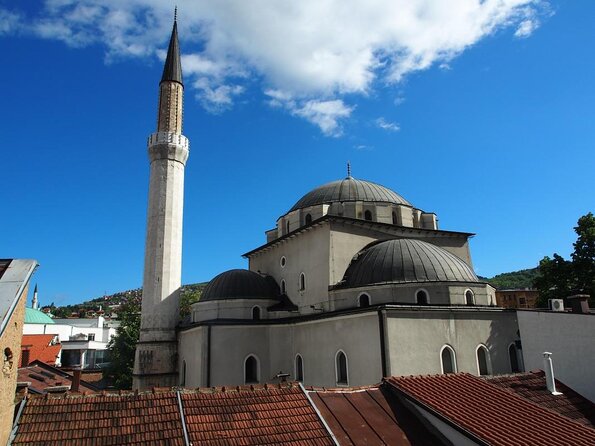
The Gazi Husrev-beg Mosque is the route’s main Islamic landmark. It sits in Baščaršija and forms part of a larger complex that includes a madrasa, library, and clock tower.
You have about 15 minutes here. The guide can explain how the mosque functioned not only as a place of worship but also within a wider setting for learning and community life. This gives the Ottoman quarter more meaning than a collection of attractive streets and old buildings.
I especially like this stop because it pairs naturally with the Old Orthodox Church. You see two different religious traditions within the same central zone, then later add the Jewish and Catholic parts of the city. That sequence makes Sarajevo’s shared urban space easier to understand.
As with any religious site, follow the guide’s instructions about entering and behaving respectfully. The supplied details do not specify dress rules or interior access conditions, so you should not assume that every part of the mosque complex will be open during your visit.
Same base, a different kind of day out:
- Sarajevo: Mostar, Konjic, Blagaj Tekke, Pocitelj & Waterfall
★ 4.9 · 1,335 reviews - Fall of Yugoslavia, Sarajevo War Tour with Tunnel of Hope Museum and Frontlines
★ 5.0 · 1,314 reviews - Sarajevo: Mostar, Konjic, Sufi House, Pocitelj & Kravice Falls
★ 5.0 · 1,179 reviews - ROSES OF SARAJEVO (Official WAR + CITY tour)- Story of a Survivor
★ 5.0 · 770 reviews
The Jewish Museum and the Sephardic story
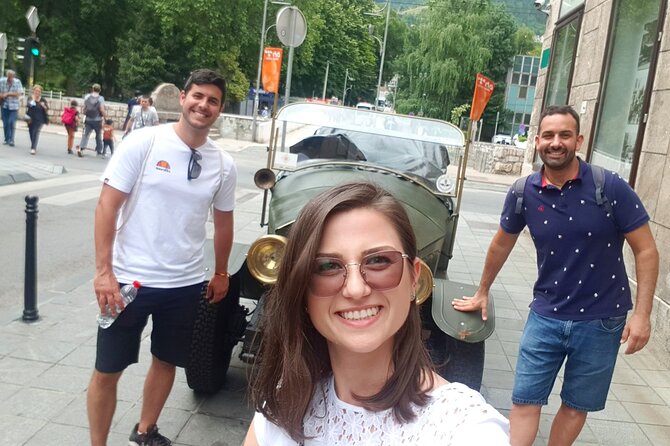
After the mosque, the route moves into the Jewish quarter and visits the Jewish Museum of Bosnia and Herzegovina. The stop lasts about 10 minutes and focuses on the Sephardic Jewish community in Bosnia and Herzegovina.
This is an important part of the tour because it widens the story beyond the better-known Ottoman and Austro-Hungarian chapters. The Jewish quarter adds another strand to Sarajevo’s past, with an emphasis on continuity and endurance through difficult periods.
The short time here means you will receive an introduction rather than a full museum visit. If your main interest is Jewish heritage, treat this tour as a starting point and allow yourself separate time to return to the museum if its opening arrangements suit your schedule.
The route’s value comes from the order of the stops. You first see the mosque, then move into the Jewish quarter, which makes the city’s religious mix feel spatial and concrete. You are not simply hearing that Sarajevo has several faith communities. You are walking between their places of worship.
Sacred Heart Cathedral and the close quarters of faith
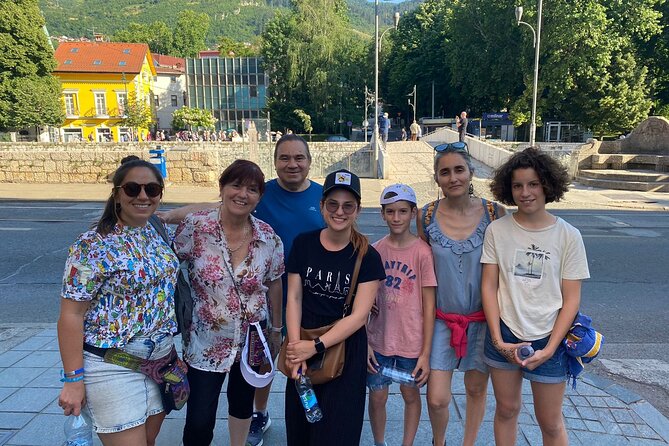
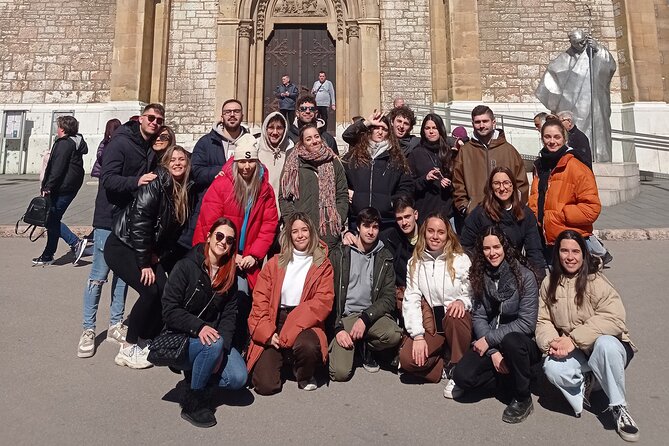
The Cathedral of the Sacred Heart of Jesus is the final major religious stop. You have roughly 15 minutes to look at the cathedral and hear how it has endured through periods of conflict.
The cathedral is especially effective in this itinerary because it completes the religious picture. The Old Orthodox Church, Gazi Husrev-beg Mosque, and Sacred Heart Cathedral are said to be only about 100 square meters apart. That is a remarkable detail, and it gives the tour one of its clearest lessons: Sarajevo’s distinct communities are not separated into distant districts. Their landmarks can sit almost side by side.
This is also where the guide can help you connect architecture with the city’s changing political and cultural life. The mosque reflects Ottoman Sarajevo, while the cathedral points to another European influence. The Orthodox church and Jewish Museum add further layers.
Again, expect a brief visit. The tour covers a lot of ground in two hours, and the schedule is built around explanation and comparison. It is best suited to you if you want a strong overview, not a slow architectural study of each building.
Latin Bridge and the moment that changed Europe
The last stop is Latin Bridge, with about 20 minutes devoted to the area. Near this bridge, Archduke Franz Ferdinand of Austria was assassinated, an event followed by the outbreak of World War I.
The guide frames the site as a place where a local street corner became tied to a global conflict. That connection can feel abstract in a textbook, but walking beside the bridge gives it a physical setting. You can see how an ordinary urban location became part of a much larger chain of events.
This is a fitting final stop because the tour has moved from Sarajevo’s long religious and civic development to one sharply defined political moment. The route does not treat the assassination as the whole story of Sarajevo. Instead, it places that event within a city shaped by Ottoman, Jewish, Orthodox, Catholic, and Austro-Hungarian influences.
The activity ends back at the meeting point. That makes the walk practical for a first day in Sarajevo, since you finish where you began near City Hall rather than being left at an unfamiliar part of town.
What the private format adds
The tour is private, so only your group takes part. That matters most if you want to ask questions about religious traditions, architecture, or the assassination without waiting for a large group to quiet down.
The named guides connected with this experience include Sanela and Amilia. The guide’s role is central here because the buildings are close together and the route depends on clear connections between them. A strong guide can explain why those sites belong in one story instead of treating them as unrelated stops.
The available feedback gives particular emphasis to guides answering questions, bringing history to life, and making the walk entertaining as well as informative. That is exactly what you should want from a two-hour city tour. The route is compact, so the quality of explanation matters more than the number of miles walked.
The tradeoff is that a private tour can feel less social than a group walk. You will not meet a large mix of other people, but you gain control over questions and conversation. For couples, families, and small groups with a shared interest in Sarajevo’s past, that is likely a fair exchange.
Is $27.61 a fair price?
At $27.61 per person, the tour offers a reasonable price for a private, English-language introduction to central Sarajevo. The listed stops have no admission charge, so you are paying mainly for the guide, route planning, and interpretation.
Value depends on the size of your party. If you are alone, the price buys personal attention but covers only two hours. If several people in your group take part, the private arrangement can feel more worthwhile because you still receive a dedicated guide rather than joining a large walk.
You are also paying for efficiency. In two hours, the tour brings together major Ottoman, Orthodox, Jewish, Catholic, and World War I sites. Building that route yourself would be easy enough, but understanding the connections between the places is harder. The guide supplies that connective thread.
The tour is not the best choice if you want lengthy interior visits, extensive museum time, or a full-day treatment of Sarajevo’s wartime period. It is better viewed as a well-packed introduction that helps you decide where to spend more time afterward.
Timing, access, and practical details
The experience lasts about two hours and is offered in English. It uses a mobile ticket, begins at Sarajevo City Hall, and returns to that same meeting point.
The listed operating period runs from October 17, 2023, through December 7, 2026, with hours shown as Monday through Friday from 8:00 a.m. to 8:00 p.m. Confirmation is sent within 48 hours of booking, subject to availability.
Most people can take part, and service animals are allowed. The meeting point is near public transportation, which makes it easier to reach without arranging a private transfer.
You can cancel without charge up to 24 hours before the start time. Changes or cancellations made later are not accepted for a refund. If the minimum number required is not met and the tour is canceled, you are offered another date or experience, or a full refund.
Who should book this Sarajevo walk?
Book it if you are visiting Sarajevo for the first time and want the central old town explained in a logical order. It is particularly useful if you want to understand how several religious communities fit into the same city rather than seeing only Baščaršija’s shops and cafés.
It also suits you if you prefer a private guide and like to ask direct questions. The route is short enough for a morning or afternoon plan, and the return to City Hall makes it easy to continue sightseeing afterward.
You may want something else if you dislike scheduled stops or need long, quiet visits inside each building. The 20-minute City Hall and Latin Bridge visits are the longest, while the church, mosque, museum, and cathedral stops run about 10 to 15 minutes each.
Should you book it?
I would book this tour as a first look at Sarajevo, especially for the private format and the close grouping of its religious landmarks. The combination of City Hall, Baščaršija, the four faith traditions, and Latin Bridge gives you a useful mental map in only two hours.
The best reason to choose it is not any single monument. It is the way the guide connects them. If you want a personal, English-language introduction at $27.61 per person, this is a practical choice. If your priority is detailed museum time or a long treatment of modern conflict, use this walk as an orientation and plan additional visits afterward.
FAQ
How long does the Sarajevo walking tour last?
The tour lasts approximately two hours.
Where does the tour begin?
It begins at Sarajevo City Hall, Brodac 1, Sarajevo 71000, Bosnia and Herzegovina.
Where does the tour end?
The activity ends back at the meeting point at Sarajevo City Hall.
Is this a private tour?
Yes. Only your group takes part in the activity.
What language is the tour offered in?
The tour is offered in English.
How much does the tour cost?
The listed price is $27.61 per person.
What sites are visited?
The route includes Sarajevo City Hall, Sebilj Fountain, the Old Serbian Orthodox Church, Gazi Husrev-beg Mosque, the Jewish Museum of Bosnia and Herzegovina, Sacred Heart Cathedral, and Latin Bridge.
Can I cancel for a full refund?
Yes. You can cancel at least 24 hours before the experience start time for a full refund.
Just added around Sarajevo
- Downhill Sarajevo MTB Mountain Biking Adventure on Trebevic – Half Day Tour★ 5.0 · 3 reviews
- Sarajevo War Tour with TRAVELPLUS★ 5.0 · 11 reviews
- Skakavac Waterfall Mountain Biking Tour from Sarajevo MTB★ 5.0 · 11 reviews
- Sarajevo: Private Transfer to and from Sarajevo Airport★ 5.0 · 19 reviews
- From Sarajevo: Visoko And Bosnian Pyramid Mistery★ 5.0 · 18 reviews
- Bosnian Traditional Handicraft, half-day – do it yourself – Coppersmith Workshop★ 5.0 · 13 reviews
- Hiking Prenj, Velika Kapa★ 5.0 · 14 reviews
- Three day Tara River Rafting and Jeep Safari Durmitor Tour★ 5.0 · 12 reviews
Historical Tours, compared.
Sarajevo Full Day Tour: History, Culture, Nature, War & Olympics
Read our review →
SARAJEVO STREET ART TOUR (art, history & mystery) – sARTajevo!
Read our review →
BOSNIAN PYRAMIDS TOUR (nature, history & archeology)
Read our review →
Browse the lists this tour appears in