
Reviewed · WALKING TOURS
Sarajevo Grand Walking Tour
Sarajevo’s story comes at you in layers: Ottoman mosques, Austro-Hungarian façades, Jewish heritage, Orthodox and Catholic churches, Yugoslav-era memories, and the scars of the 1990s war. This three-hour walking route gives you a useful map of that complicated past, ending with the city’s main market streets and civic landmarks.
I like two things especially. First, the tour visits places you could easily pass without understanding, such as the Spite House and the Meeting of Cultures marker. Second, the guides often add personal perspective, including memories connected to the war and practical tips for ćevapi, coffee, and other local stops. The main drawback is simple: you cover a lot of ground, and a larger group of up to 30 people may feel less personal than a private tour.
Key points before you book
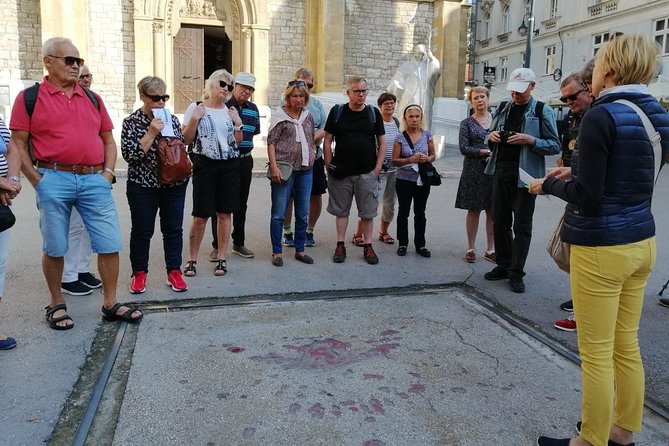
- A full history of Sarajevo in three hours: The route moves from the Ottoman period through Austria-Hungary, Yugoslavia, World War II, and the 1992 to 1995 war.
- Nineteen major stops and several extra streets: You see the Latin Bridge, Sarajevo City Hall, Baščaršija, the major religious buildings, Markale Market, and more.
- Guides make the difference: Past tours have been led by Suad, Hana, Haris, Emina, Denis, Masha, Alem, Kenan, Fariz, Ilma, and others.
- A useful first-day activity: You receive a city map and local suggestions for food, coffee, and places to visit later.
- Good value at $20.57: The price covers the guide and map, but not lunch, drinks, or admission and tax charges.
- Easy route, but still a lot of walking: The route is mostly flat, though three hours outdoors calls for comfortable shoes and weather-ready clothing.
Sarajevo’s whole story in one city walk
This is not just a parade of old buildings. The route shows how Sarajevo became a meeting point for different faiths, empires, and political systems.
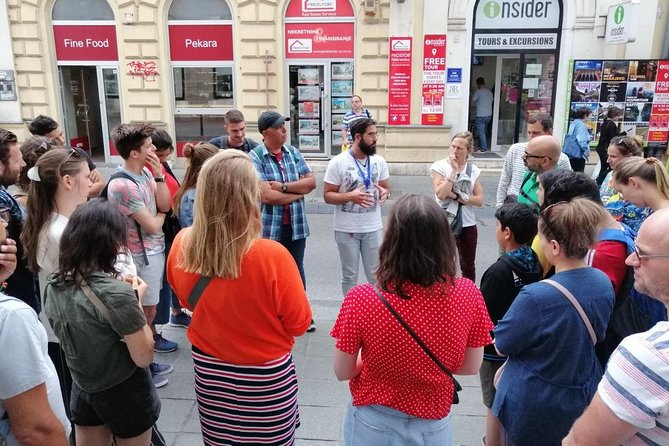
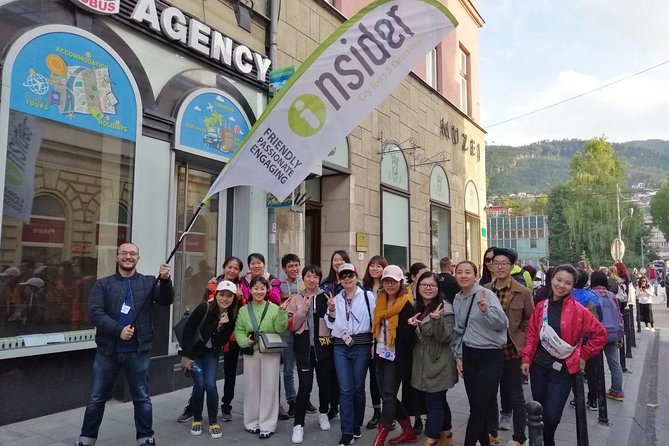
You begin at Sarajevo Insider, at Zelenih beretki 30, close to the historic center. From there, the walk traces the Miljacka River and heads into the old town. The sequence makes sense: first the city’s political and religious foundations, then its Ottoman market quarter, followed by its major twentieth-century landmarks.
You should expect a steady stream of explanation rather than long indoor visits. Several stops last only two or three minutes, while the Latin Bridge, City Hall, Baščaršija, Kazandžiluk streets, Gazi Husrev Bey’s Mosque, and the Eternal Flame receive more time.
That format works well if you want orientation. You will not receive a full museum visit at every stop, but you will learn what deserves a closer look later.
A few more things to do around Sarajevo
- Sarajevo: 2 Hours Old Town Walking Tour With Local Guide
★ 5.0 · 505 reviews - Private Walking Tour, Food Tasting and Bosnian Coffee in Sarajevo
★ 5.0 · 255 reviews - Sarajevo Essential Full Walking Tour
★ 5.0 · 198 reviews
The Latin Bridge and the spark of World War I
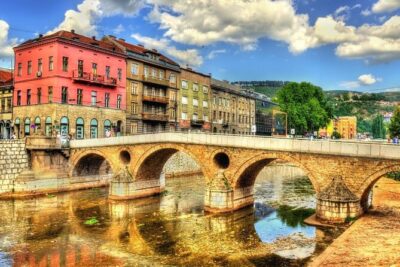
The first major stop is the Latin Bridge, one of Sarajevo’s best-known landmarks. Nearby is the assassination site of Archduke Franz Ferdinand in 1914, the event that helped set World War I in motion.
The guide places the event in Sarajevo rather than treating it as a detached European history lesson. You can look at the river, streets, and surrounding buildings while hearing how one local act became part of a much wider crisis.
The stop lasts about 12 minutes, which is enough for an explanation and questions. It is also a good early sign of the tour’s approach: Sarajevo is presented as a place where local events repeatedly had international consequences.
At Mejdan Park, the pace briefly softens. This small green space by the Miljacka offers a quieter setting and a chance to see the river as part of daily city life, not just as a backdrop for historic buildings.
Mosques, churches, and Sarajevo’s religious mix
The next section introduces the city’s main faith traditions. The Emperor’s Mosque is associated with Sarajevo’s oldest Islamic heritage and offers a short look at the Ottoman foundations of the city.
The Franciscan Church of Saint Anthony brings a Catholic presence into the route. Later, you see the Cathedral of the Sacred Heart and the Serbian Orthodox Cathedral. Together, these stops help explain why Sarajevo is often described as a city where different religious communities lived close together.
The stops at the churches are brief, usually around five minutes. If you want extended time inside each building, this tour may feel too fast. If you want a clear introduction to the city’s religious geography, the sequence works well.
At the Serbian Orthodox Cathedral, the guide points out the interior decoration, murals, and domes. The Cathedral of the Sacred Heart is a major Catholic landmark, often compared with Notre Dame because of its scale and role in the city.
The Jewish Museum adds another important strand. The Old Jewish Temple connects Sarajevo with its Sephardic Jewish community and the Sarajevo Haggadah, one of the city’s most significant cultural treasures. The stop is short, but it gives you a reason to return for a longer museum visit if your schedule allows.
The brewery and the House of Spite
The Sarajevo Brewery is a reminder that the city’s story is not only about worship and politics. It is linked to Bosnia’s oldest industrial complex and traditional beer production.
Then comes one of the tour’s most entertaining architectural stories, the House of Spite. The building is tied to a local act of defiance and was rebuilt brick by brick after its original location became part of a major civic project.
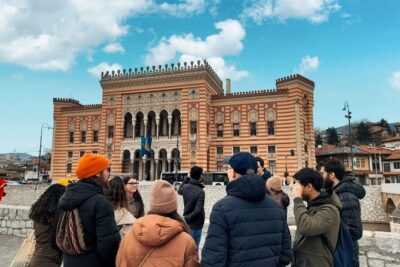
The story is easy to remember because it turns a building into a character. It also leads naturally to Sarajevo City Hall, a grand neo-Moorish structure that combines European planning with decorative forms associated with the Islamic world.
City Hall receives about 10 minutes, making it one of the longer stops. Look closely at the exterior details and listen for the explanation of how Sarajevo’s architecture reflects its position between East and West.
The route also passes the Bosnian House Bicakcic-Hadzisabanovic, described as a modernist building with an important place in Sarajevo’s past. Since the scheduled stop is brief, you should think of it as a visual cue rather than a full architectural tour.
Same base, a different kind of day out:
- Sarajevo: Mostar, Konjic, Blagaj Tekke, Pocitelj & Waterfall
★ 4.9 · 1,335 reviews - Fall of Yugoslavia, Sarajevo War Tour with Tunnel of Hope Museum and Frontlines
★ 5.0 · 1,314 reviews - Sarajevo: Mostar, Konjic, Sufi House, Pocitelj & Kravice Falls
★ 5.0 · 1,179 reviews - ROSES OF SARAJEVO (Official WAR + CITY tour)- Story of a Survivor
★ 5.0 · 770 reviews
Kovači Cemetery and the memory of the 1990s war
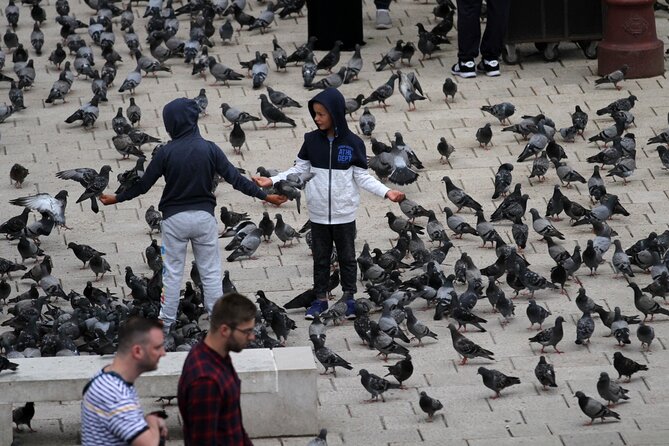
Kovači Cemetery is a national memorial for Bosnia’s defenders from the 1992 to 1995 war. The stop is quiet and reflective, with about three minutes set aside for explanation.
The tour does not treat the war as the only important part of Sarajevo’s story. That balance matters. You learn about the siege and recent conflict, but also about the Ottoman city, Austria-Hungary, Jewish life, religious buildings, and the city’s present-day identity.
Some guides have personal connections to the period. One guide was described as old enough to remember the war and able to discuss it with both honesty and optimism about Bosnia’s future. Other guides have shared family stories, including memories connected with a parent.
That personal element can make the subject more immediate. It can also make the tone vary from one departure to another, since each guide brings a different style and life experience. The strongest guides appear to combine facts with personal stories without allowing the tour to become only a war talk.
Kovači Street follows with Ottoman-era character and local shops. It is a useful transition from a memorial site back into everyday Sarajevo.
Baščaršija, metalwork, and the best place for a food tip
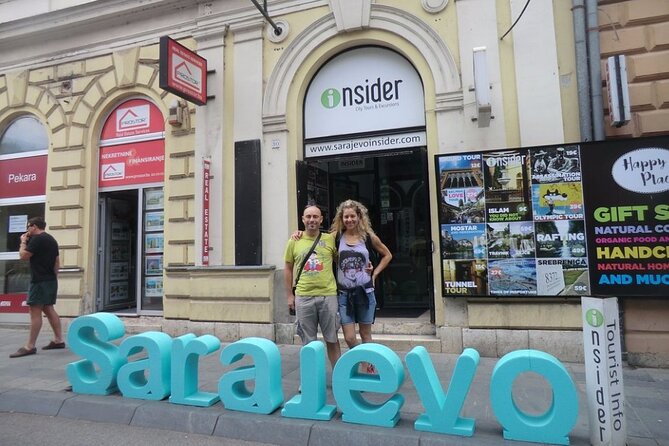
Baščaršija is the heart of Sarajevo’s old marketplace. Here, the route becomes more sensory. You see small streets, traditional trades, historic buildings, and the flow of people moving between shops and cafés.
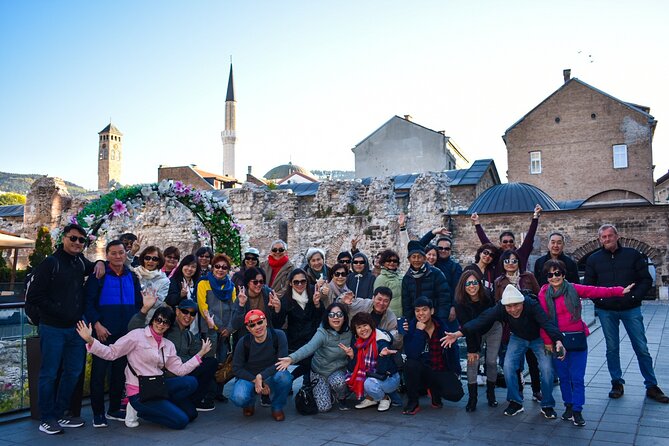
The tour gives this area about 15 minutes, the longest stop on the route. That is enough to get your bearings, but you will want to return on your own for food and browsing.
Kazandžiluk and Bravadžiluk streets add more detail. Kazandžiluk is linked with traditional copper and metalwork, while Bravadžiluk is associated with food. These lanes show how the old market district still connects craft, commerce, and eating.
The Sebilj Fountain is one of the most recognizable points in Baščaršija. You hear the local legend that drinking from it means you will return to Sarajevo. The stop lasts around five minutes, so you have time for a quick look and perhaps a drink from the fountain.
Morica Han is Sarajevo’s last Ottoman inn. Its courtyard recalls the days when merchants and visitors stayed in the commercial center. It is a compact stop, but it helps you picture Baščaršija as a working trade district rather than a preserved tourist display.
The guides often give practical food advice during this part of the walk. Specific recommendations for ćevapi, coffee, and local restaurants have been an important part of the experience for many people. I would take notes, because these tips can save you from choosing a restaurant at random later.
Gazi Husrev Bey’s Mosque and the Meeting of Cultures
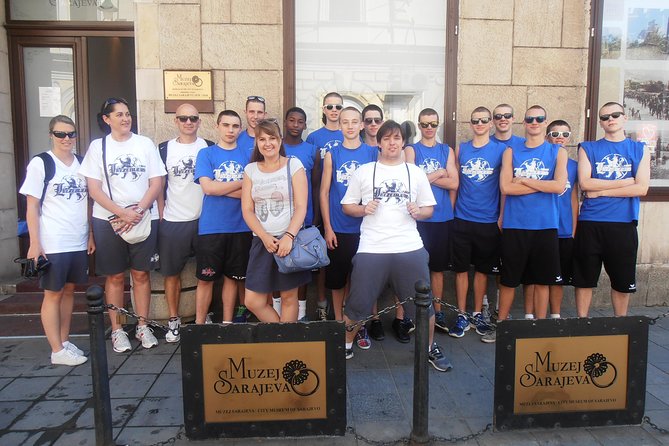
Gazi Husrev Bey’s Mosque is one of the key monuments of Ottoman Sarajevo. The mosque dates from the sixteenth century and remains one of the city’s major religious and architectural sites.
The tour allows about 10 minutes here. That is long enough to understand its role and appreciate the setting, though visitors should follow any current rules about entering religious buildings.
The next stop, Sarajevo’s Meeting of Cultures marker, is small but clever. It identifies the point where the Ottoman character of the old town gives way to the Austro-Hungarian part of the city.
You can see the change in architecture within a short walk. That makes the marker valuable for orientation. It is not a grand monument, but it helps you read the city as you continue.
The Cathedral, Markale Market, and the Eternal Flame
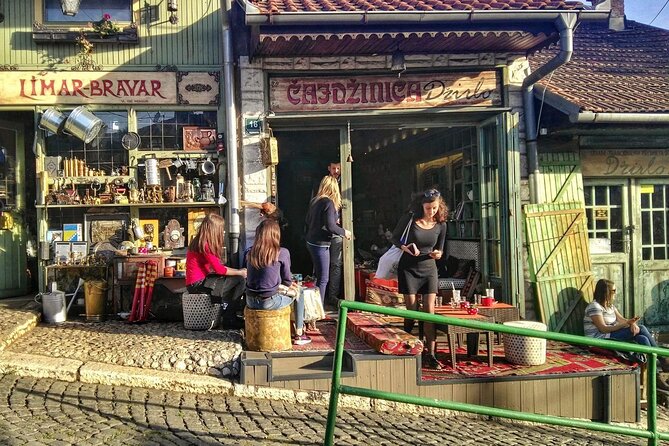
The route then moves toward the Cathedral of the Sacred Heart, the Serbian Orthodox Cathedral, and Markale City Market.
Markale is still a working market, not merely a historic stop. You can expect local produce, everyday shopping, and a sense of how Sarajevo functions beyond its monuments. The scheduled visit lasts about five minutes, so you will likely want to return if you enjoy markets.
The final landmark is the Eternal Flame, a World War II memorial dedicated to remembrance and resilience. It gives the walk a civic ending, linking Sarajevo’s wartime past with the city center you have just crossed.
By this point, you will have seen how close the city’s major religious, political, and commercial landmarks are to one another. That is one of the tour’s best lessons. Sarajevo’s history is not divided into distant chapters. The buildings sit side by side, and the walk makes those connections visible.
What $20.57 gets you
At $20.57 per person, this is a strong value if you want a serious introduction to Sarajevo rather than a short photo walk.
The fee includes a guide and a city map. It does not include lunch, coffee, tea, all fees, or taxes. The scheduled stops are generally free, but you should not assume every possible interior visit or added expense is covered.
The tour is offered in English and usually lasts about three hours, with some departures running closer to three and a half hours depending on questions and pacing. The group can reach 30 people, so the exact feel depends on attendance.
A private upgrade is available if you want more control. That option makes sense if you care about a particular subject, need a custom start or end time, or want to ask many questions without holding up a group.
How the guides shape the experience
The company uses several guides, and the names associated with this tour include Suad, Hana, Haris, Emina, Denis, Masha, Alem, Kenan, Fariz, Ilma, and others.
The most praised qualities are clear English, strong command of Sarajevo’s history, personal storytelling, and a willingness to answer questions. Guides such as Hana and Haris are noted for keeping a large amount of information easy to follow. Suad is associated with a particularly engaging three-hour walk, while Emina and Denis have been singled out for warmth and personal connection.
Alem has been praised for combining enthusiasm with practical recommendations. Kenan is remembered for adding small details and giving a good ćevapi suggestion. These details matter because a city walk should help you use the city after the tour ends.
Guide quality can vary. One solo participant found the delivery too mechanical and wanted more personal attention. That is a fair caution, especially when a group is very small or the guide’s style is more formal.
Practical advice for your three hours
Book this early in your stay if you can. The route gives you a working map of the old center, and the food and coffee suggestions are more useful when you still have days left.
Wear comfortable shoes and bring an extra layer. The tour is outdoors and depends on good weather. One past participant specifically advised warm clothing, which is sensible for a three-hour walk beside the river and through open streets.
The route is described as easy and mostly flat, but easy does not mean short. You will be on your feet for most of the experience, with many stops and a steady amount of walking.
Confirmation arrives at booking. Service animals are allowed, public transportation is nearby, and most people can take part. The tour ends back at the starting meeting point at Zelenih beretki 30.
Free cancellation is available up to 24 hours before the start time. Late cancellations are not refunded, and changes inside that 24-hour window are not accepted. The activity may be rescheduled or refunded if bad weather or too few bookings prevent it from running.
Should you book the Sarajevo Grand Walking Tour?
I would book it if you are visiting Sarajevo for the first time, want the city explained in plain language, and enjoy connecting buildings with political and religious history.
It is especially useful for people who want more than the 1992 to 1995 story. You will hear about the Ottomans, Austria-Hungary, Yugoslavia, World War II, Jewish Sarajevo, and the city today.
Choose the private option if you want a slower pace, a custom focus, or a more personal exchange. Skip this tour if three hours of walking sounds tiring or if you prefer spending long stretches inside museums.
For most first visits, the price is modest for the ground covered. You leave with a map, a list of landmarks, a better sense of Sarajevo’s complicated past, and practical ideas for what to eat and see next.
FAQ
How long does the Sarajevo Grand Walking Tour last?
The tour lasts approximately three hours. Some departures may run closer to three and a half hours depending on the pace and questions.
What language is the tour offered in?
The tour is offered in English.
Where does the tour begin?
It begins at Sarajevo Insider, City Tours and Excursions, Zelenih beretki 30, Sarajevo 71000, Bosnia and Herzegovina.
Where does the tour end?
The activity ends back at the meeting point.
What is included in the price?
The price includes a guide and a city map.
Are food and drinks included?
No. Lunch, coffee, and tea are not included.
How many people can join the tour?
The maximum group size is 30 people. A private tour upgrade is also available.
Can I cancel for a refund?
Yes. You can cancel at least 24 hours before the start time for a full refund. Cancellations or changes made less than 24 hours before the start time are not accepted for a refund.
Just added around Sarajevo
- Downhill Sarajevo MTB Mountain Biking Adventure on Trebevic – Half Day Tour★ 5.0 · 3 reviews
- Sarajevo War Tour with TRAVELPLUS★ 5.0 · 11 reviews
- Skakavac Waterfall Mountain Biking Tour from Sarajevo MTB★ 5.0 · 11 reviews
- BOSNIAN PYRAMIDS TOUR (nature, history & archeology)★ 5.0 · 17 reviews
- Herzegovina Tour – Mostar, Blagaj, Počitelj & Kravice waterfalls★ 5.0 · 15 reviews
- CENTRAL BOSNIA | A medieval tour (Jajce + Travnik + Pliva lakes)★ 5.0 · 11 reviews
- Sarajevo: Mostar Konjic Blagaj Pocitelj Fortica Skywalk Waterfall★ 5.0 · 14 reviews
- Balkan trip★ 5.0 · 11 reviews
Walking Tours, compared.
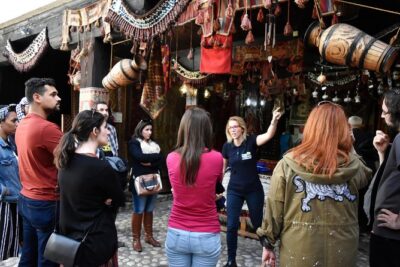
Private Walking Tour, Food Tasting and Bosnian Coffee in Sarajevo
Read our review →
Delicious Sarajevo: Eat, Walk & Discover City Tour
Read our review →
PROFESSIONAL SARAJEVO WALKING TOUR – With guide who guided STING!
Read our review →
Sarajevo genuine walking tour: Steps through history
Read our review →Browse the lists this tour appears in